
Does the term ‘grey nomads’ really suit us to a ‘tea’?
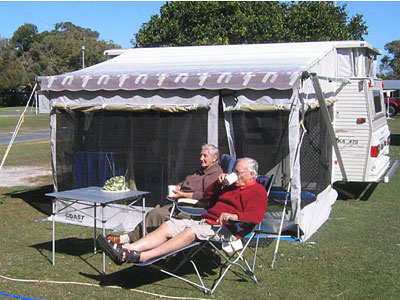
With the roads north filled with countless clusters of caravans and motorhomes, the term ‘grey nomad’ is once again being used as an insult by an army of impatient non-holidaying motorists.
But is it seen as an insult by those on the receiving end? Or is the label one that is worn with pride by those who have it thrust upon them?
Opinion it seems is divided.
Experts say that, while being called a grey nomad could be seen as isolating people from their past and labelling them ‘placeless’ and ‘jobless’, it could also be seen as indicating a lifetime of experience, and liberation from the constraints of work and home,
Academic Dr Karen Brooks, claims that while most labels are initially started as nothing more than a marketing tool, they can inadvertently give people a real sense of identity
“Being called a grey nomad gives some travellers a sense of community,” said the associate professor at the University of Queensland’s Centre for Critical and Cultural Studies. “Couples and individuals on the road take comfort in knowing that there are others out there like them who share their aims and dreams.”
She says being called a grey nomad is a way of explaining a life stage … of saying that someone is retired, that they are independent, that they are doing something different.
However, she told www.thegreynomads.com.au that the term could also be said to be too all-inclusive and of not taking account of the fact that all travellers are individuals with unique sets of circumstances.
And, she accepted it could be a term of considerable prejudice.
“It can be pejorative, it can be used to be dismissive to older people,” she said. “Clearly people say ‘bloody grey nomads’ when they are stuck behind a caravan on the highway, or when they are on their summer holiday and the caravan park is full.”
However, Ms Brooks warns that things are not always as black and white as they may seem.
“Perhaps the younger people who are issuing the abuse should be thinking about their future and how one day it will be them sitting there in their caravans,” she said. “Ultimately, it is all about how the individual reacts to the label … some people love it and embrace it, while others don’t feel comfortable with it and reject it.”