

While many grey nomads view the rusty car wrecks, some of which have been transformed into quirky works of art, as just part of the Outback drive experience, it seems you can get too much of a good thing.
As this year’s abandoned vehicle joins last year’s, and the year before that, and then all of the decades preceding, suddenly you’ve got an eyesore issue which can’t be solved with a pair of litter tongs and a giant plastic bag.
Now, the ABC reports that a study conducted across five Outback Queensland shires has identified 200 derelict cars that needed removal.
Members of the North West Queensland Regional Organisation of Councils (NWQROC) engaged the Southern Gulf Natural Resources Management (NRM) group to map abandoned vehicles across Burke, Carpentaria, Cloncurry, Flinders, and Mount Isa City council shires.
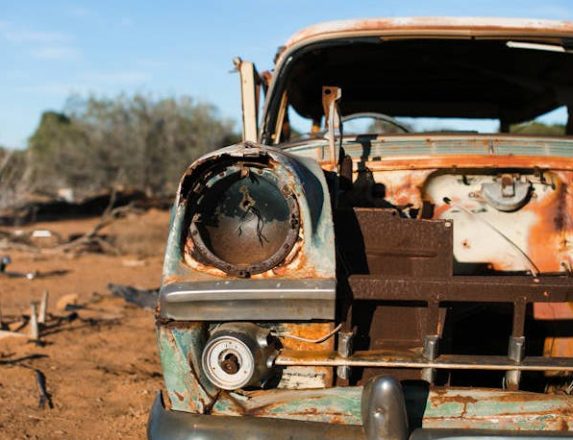
Rusted-out car wrecks have become a familiar part of the Australian landscape. PIC: Rachel Claire / Pexels
The plan is now to target identification, and then tender for removal of car ‘skeletons’ as well as finding a way to reuse or recycle material and batteries.
NWQROC executive officer Greg Hoffman told the ABC that tackling the presence of legacy waste in the region was a priority.
 “Tyres and abandoned cars are the biggest issue plaguing waste in the region, they have nowhere else to go,” he said. “It presents a fire hazard and it’s also a blight on the environment.”
Mark van Ryt, a volunteer with the Gulf River Landcare group, said the issue was beyond the scope of his small group, but he speculated that if a bounty was perhaps put on car wreck of maybe a few hundred dollars, some locals might get involved.
He said, while some vehicles had been there for 60 years or more and had effectively become local landmarks, many more had been arriving in recent years.
“They don’t belong here, it’s time to clean them up,” he told the ABC. “You do drive out to places and might see a vintage car wreck, and it’s a landmark, but when they start popping up everywhere it becomes shocking.”
Are you a Grey Nomad member yet? Click here to find out about the discounts, competitions and other benefits on offer.





Personally I like looking at old car wrecks.
Back then cars were made of steel not plastic. LOL.
I agree I like seeing the OLD WRECKS and wonder how they got there ,what went wrong and the story behind them .
I think in some cases they maybe part of history
But ones that have arrived in say the last 50 years should be removed .
With you on that one.
Any old wreck older than 60 odd years is a landmark, but anything under that becomes an eyesore. Just remember there are critters out there that will live in those wrecks. so whoever is making the group one decision has to take that into account.
Abandoning a car wreck or burnt out skeleton of a vehicle should be treated stricter then in urban areas. It’s called littering/illegal dumping.
They’re part of history. History should always be maintained or at the very least left there. The excuse that tyres are a fire hazard does not ring true.
My wife and I both feel that much of the abandoned equipment and car wrecks are indeed just a blot on the landscape, left there because it was all too hard to dispose of them correctly and would be better for the environment if they were removed. Some places we’ve been to have old broken glass bottles and cordoned off asbestos areas, that should be cleaned up. If there is some kind of historical significance then a sign to state what it is would be useful. But as for the rest, clean it up, it’s junk.
A blight! For sure. The older cars have a certain charm about them and sort off add to the experience in the outback. But as time goes on and people of lesser intelligence, dump their old cars (rubbish) then, no it has to be stopped. Where does it end? I know it maybe a extra burden on local authorities, but if they were to provide a dump facility (area) where locals could dump their old cars and in time be recycled, perhaps that would advantageous to everyone and the environment.
Careful. They many be scared sites.
We have done about 100,000 km caravanning around our big green and red country in particular the outback. We have seen may old rusting wrecks out there as well as newer vehicles abandoned often jacked up and wheels removed.
We must also consider wrecks in the outback be they old or newer may be 100’s of km’s from a town and that town in the outback probably has no recycling facilities and the cost of removing them would be huge.
So, what is the solution?
We counted over 200 wrecks on the Great Central Road on the 3 day trip between Leonora and The Olga’s. Some were Land Cruisers not more than 15 years old. Sacred Sites no doubt!
Very annoying.
They are a constant reminder of our hard earnt taxpayer money being squandered over many years. I’d rather look at emus!
I don’t mind them.
Hard to start, though!
I recently drove the Great Central Track and was astonished at the sheer volume of wrecks. Commodores mostly but Falcons and Japanese models too. Literally hundreds of wrecks on that 1100 km drive. Very remote so would be a long and costly exercise to take a mobile crusher out there to deal with it. However it needs to be done as the owners take no responsibility for their wrecks.
If you want to see wrecks and dumped machinery, have a look at Coober Pedy
That’s very true. And they are not sacred sites
There used to be a guy who picked up car wrecks and took them in for recycling, on a TV show, possibly Outback Truckers. I wonder if he is still doing it? I think any wrecks associated with important historical events should be left there with a relevant sign. For example if there were any wrecked vehicles left from the construction of the Central Highway, they might be considered historically important. New wrecks should be removed.
I can see nothing wrong with these unique Australian automobile icons sitting in parks and properties. These old cars could have played a major role in opening up the remote areas we now travel through and take for granted. I reckon if they could tell you their stories then you might not look at them as rusty wrecks but perhaps as a part of our motoring history.
I think they should be removed, they an eyesore, they can be recycled as scrap.
I agree with earlier thoughts that any vehicle younger than 50-60 years should be removed.