

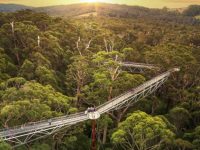
Conservation groups are calling for an end to a prescribed burn program which they say has led to the collapse of more than 150 giant Tingle and Karri trees next door to the famed Valley of the Giants Treetop Walk in WA’s south west.
The WA Forest Alliance (WAFA) says the ‘Giants East’ forest block in the Walpole-Nornalup National Park was ignited in late December by the Department of Biodiversity, Conservation and Attractions (DBCA).
Now local researchers are disputing claims that just one giant Tingle tree collapsed in the burn, and that 300 other Tingle and Karri trees on the burn perimeter had been protected.
Local resident and ANU environmental science student, Uralla Luscombe-Pedro, surveyed the area for fire-felled trees after the Giants prescribed burn.
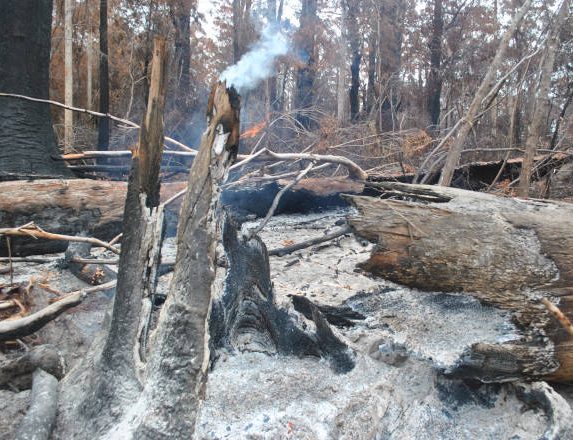
A smoking stump in the burn area. PIC: Uralla Luscombe-Pedro / WAFA
She estimated 180 mature red tingle, yellow tingle, karri and marri trees were felled by the burn in an area less than 100 hectares.
“Large fallen trees, branches and entire tree canopies that were burned off their trunks are scattered across the forest floor, and in some places, trees have collapsed in groups,” she said. “From any standpoint in the forest, it’s clear this was a severe and damaging fire.”
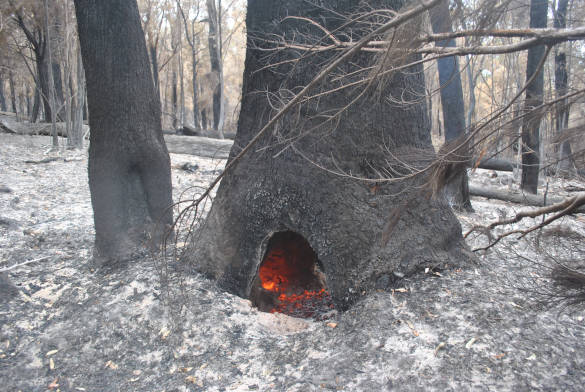
Conservation groups say trees continued to smoulder weeks after the burn. PIC: Uralla Luscombe-Pedro / WAFA
Yahoo News reports that the ground where the fire occurred is still pockmarked with smouldering holes and many of the surviving trees are compromised and could fall.
“It’s actually quite dangerous in that section. You fall down these holes and suddenly you’re waist deep and there’s still hot coals at the bottom,” Jason Fowler from the WA Forest Alliance (WAFA) told Yahoo News. “To visit, you’ve got to wear fire boots, be all covered up, and be prepared for anything … when strong winds come through trees drop all over the place because their roots have been burnt out.”
The WA Forest Alliance says Tingle trees’ shallow roots, fibrous bark, burls and gnarls, make them susceptible to frequent and severe fire. It says each burn sets up more trees to fall in the next fire event because of the cumulative damage that burning does to their structure and stability.
Recent studies show that Tingle forests have naturally low flammability when they are left unburnt for long periods.
The Walpole-Nornalup National Park Association (WNNPA)’s said it first raised concerns about the burning of the Tingle forest more than 30 years ago, and said it was ‘incredibly shocked and disappointed’ on seeing the outcomes from the recent prescribed burn in Giants East block.
 The WNNPA is calling for a halt to another burn planned in nearby Tingle forest later this season and is supports a call for an increase in pre- and post-fire monitoring programs, and an independent review into prescribed burning.
WA Forest Alliance (WAFA) Senior Campaigner Jason Fowler, the government needed to overhaul the prescribed burning program to prevent unnecessary destruction.
“Urgent changes are required to ensure fire-sensitive species and communities like tingles are not burnt in this manner,” he said.
WA’s Department of Biodiversity, Conservation and Attractions says prescribed burning is the process of planning and applying fire to a predetermined area, under specific environmental conditions, to achieve a desired outcome.
“The department uses prescribed burning for a number of purposes,” it says. “To mitigate the severity of bushfires and to help protect lives and property by reducing the build-up of flammable fuel loads; to maintain biodiversity; to rehabilitate vegetation after disturbance, such as timber harvesting and mining; to undertake research on fire and its interaction with our environment.”
Are you a Grey Nomad member yet? Click here to find out about the discounts, competitions and other benefits on offer.








Stop the burning of National Parks
Prescribed burning has to be done to reduce the fuel load on the forest floor. If we don’t burn, Mother Nature will do it with a lightning strike.
What birdbrain would do a burn off in the middle of summer and then wonder why it destroyed so many trees , burn off should be done early spring or autum
As an environmentalist, I have concerns over “prescribed” burns. There are so many factors to take into account like, time of year, the amount of fuel on the ground and weather conditions are just a few. But, Climate Change has really changed the window for low level burns (any burns). Most of the initial fuel load on a forest floor are leaves, twigs and dried grasses which at the wrong time of burning causes larger types of fuel to burn which then causes these destructive fires. So, only burn when conditions are right, low wind, high humidity, low temperatures and promise of rain.
Instead of “prescribed burning” how about using a more natural method. In N.S.W. the R.F.S. have experimented with enclosed goats to clear the understory with promising results. More research needed.
They would not have the brains to think that.
They order a goat cull to protect the environment.
How can we get this so very wrong? They are supposed to be conservationists yet they destroy this unique and beautiful block of ancient forest. Where are the collaborations with our first people’s? Breaks my heart. Is there a petition to sign to prevent the next planned burn?
Prescribed burns can be a very effective way to reduce fuel loads and to regenerate the bush.
Forest that has had a burn can often regenerate into a much better area by the removal of choking understorey and many Australian plants generate because of the smoke.
As someone who has lived in the Perth Hills in a very heavily timbered area for the last 50 years, I am an advocate of prescribed burns. Without them we can see what can happen by the devastating fires in NSW and Victoria a few years ago.
However, having said that, prescribed burns used to be done in a manner with much cooler burns being used.
In more recent times it would seem that an attitude of let er rip has infested our forestry services with aerial fire bombing now the norm which then brings on these very large and hot fires that are devastating to the environment.
It might save manpower and time but is not how first nations people did it who managed the Forests a lot longer than we have with some success.
Burning too in hot weather which often occurs is madness and I often wonder if the pen pusher who orders these burns to be done even knows much about them.
I believe that whilst prescribed burns are an essential fire management tool, how they are performed must have a complete review of that process.