
The excitement surrounding meteor showers in recent weeks has certainly been enough to get plenty of grey nomads looking skywards ready to enjoy the show.
Just this week, people across WA were stunned to see a meteor flash across the night sky, before crashing into earth at a speed of around 34 kilometres per second.
The Perth Observatory said on its Facebook page that the object was ‘a fragile cometary fragment, a piece of icy, dusty debris left over from the early stages of the Solar System’.
It said that as the object ‘hit our atmosphere, it began to heat up and break apart, producing a series of dazzling flashes’. The object was destroyed with no fragments reaching the ground.
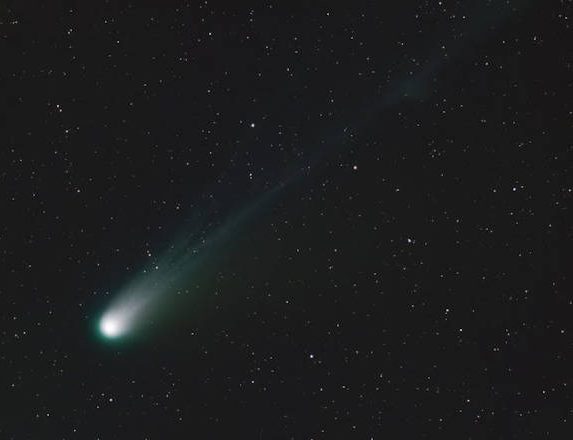
The night sky can throw up some amazing light shows. PIC: Scott Lord / Pexels
And, of course just a couple of weeks ago, grey nomads were on high alert to catch a glimpse of the much-anticipated Southern Delta Aquariids and the Alpha Capricornids showers.
But there’s more to meteor tourism that simply watching them fly across the sky on those glorious Outback nights.
There are a number of vaguely accessible meteor impact sites across Australia, including WA’s iconic Wolfe Creek Crater, which is a whopping 870 metres wide; and the NT’s Henbury Meteorites Conservation Reserve, where some 13 craters can be found.
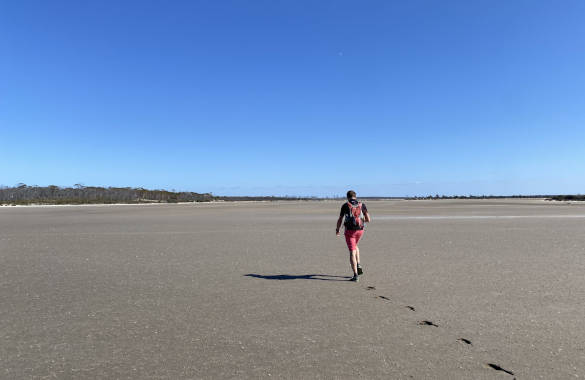
A member of the Curtin University team goes off searching for the impact site. PIC: Curtin University
And, the quest for new meteor impact spots goes on.
Back in May, a dazzling meteor lit up Western Australian skies and Curtin University’s Desert Fireball Network (DFN) set out to track it down.
Using high-tech weather modelling and a network of cameras, the DFN team embarked on an exciting journey deep into the Australian Outback, to discover where the space rock landed – and where it may have come from.
They tracked the meteorite to the Wheatbelt region of WA, into the remote salt flats of Lake Hope, 530 kilometres east of Perth.
That sparked an adventure requiring hundreds of kilometres behind the wheel, hours of off-road four-wheel-driving. A final seven-kilometre trek by foot across Lake Hope finally brought the researchers to the impact zone, where DFN team member Mia Walker made the big discovery, the impact clearly visible on the stark white of the Salt Lake.
“It was so amazing to be the first person to ever touch it,” she said. “This piece of rock is older than the Earth and was in space just a few days ago.”
The team soon discovered a second fragment not far from the first.
DFN Director, Dr Ellie Sampson, said meteorite falls such as this are valuable for researchers, as they can match the rock type to its origins in the solar system by calculating the impacting orbit.
“There are only about 60 meteorites globally that we have orbital information for; this is the 10th in Australia, tracked and recovered by the DFN”, Dr Sansom said. “This meteorite comes from a particularly interesting orbit and it’s invaluable to have retrieved as much of it as we have.”
 WIN ONE OF THREE SKID ROW TRAILER SKIDS
Grey Nomad members are being given the opportunity to win one of three Skid Row Trailer Skids (each valued at $199). The ingenious Australian-designed device could come to the rescue of nomads who find their trailer or van stuck on sand, mud, or worse.
Manufactured from high-grade polypropylene, the ‘skid’ has been designed for use with or without the jockey wheel to accommodate different conditions in the retrieval process. The device is very compact (77cm x 39cm x 21cm), making it easy for grey nomads to store, and it weighs just 3.8 kilograms.
Click here to find out more.