

Herds of massive bull camels are wreaking ‘havoc’ in communities across regional Australia … and the Northern Territory government is calling for urgent help to address the problem.
Most grey nomads who have spent time travelling in remote areas of the country will be familiar with the fact that the giant ‘ships of the desert’ are present in big numbers, and will also be aware of the dangers they can pose to motorists.
And it seems the issue is getting worse, not better.
The Territory Government says a dry spell in Central Australia over the past six months has led to large groups of camels moving into communities in search of water, and they are damaging water mains and fences in the process.
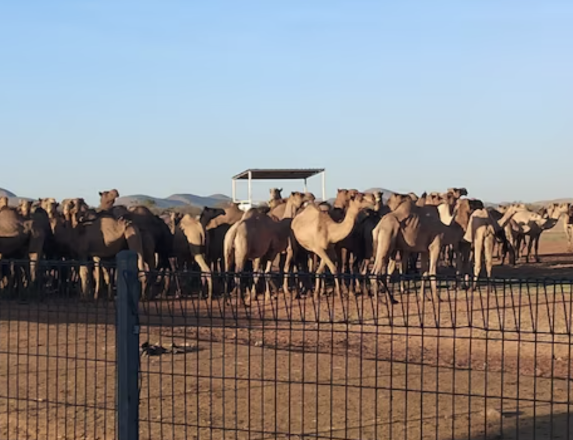
Feral camels are wreaking havoc as they seek water after a prolonged dry spell in Central Australia. PIC: NT Government
Among the places that have seen a huge influx of the feral animals is Mount Liebig, an indigenous community located about 305 kilometres west of Alice Springs.
The ABC reports that the NT government is now calling on Commonwealth support to help cull the animals ‘back to manageable numbers’.
NT Lands, Planning and Environment Minister Josh Burgoyne said it was a serious problem.
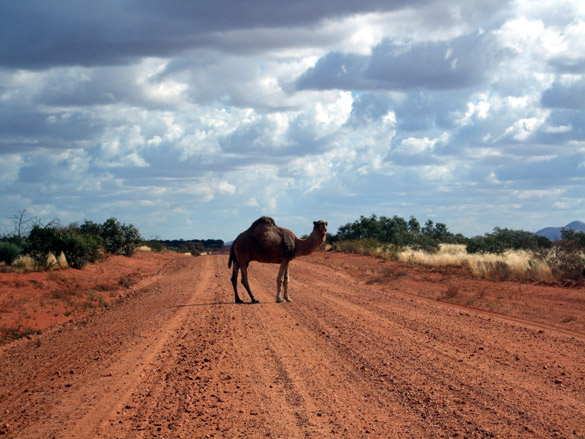
Feral camels can be a hazard for Outback travellers.
“What happens during these dry spells is that these camels that are usually out in the desert will come into these local communities, being able to smell the water,” he said. “These camels have been coming in, damaging fences, and actually digging up water mains around local houses … this has meant that, over a summer period where we have seen temperatures exceed 40 degrees, some remote houses have actually been without water.”
And Mr Burgoyne said it wasn’t just the damage to infrastructure that was causing alarm.
“For some people it might seem a world away, but for these communities on the ground, imagine waking up one morning and seeing hundreds of camels in your local community — and they can get quite aggressive,” he said. “We’re talking about large bull camels weighing hundreds of kilos that just want water, and they’re willing to do anything … to try and get it.”
Several years ago, after a man was badly injured when his vehicle ran into a herd of camels on the Lasseter Highway, police warned grey nomads of the very real danger of hitting wandering stock or large animals, especially at night.
At the time, it was said there were an average 2.17 camel-related crashes annually in the Northern Territory alone … many of them serious. Camels also create another major hazard for vehicles by taking dust baths on the road, piling heaps of soft sand on an otherwise smooth surface.
 The ABC reports that camels were first introduced to Australia in the 1840s to help early travellers transport goods across the vast desert regions.
There are now estimated to be up to one million feral creatures in Australia, with the animals apparently found across more than 40% of land in the NT.
The NT Government says that, in much of the Territory, there are more than two camels per square kilometre, which causes serious impact on native vegetation.
Feral camels have an impact on fragile salt lake ecosystems and contribute to erosion by destabilising dune crests.
Between 2009 and 2013, a federal government-supported initiative, the Australian Feral Camel Management Project led to the culling of 160,000 camels in Central Australia.
The ABC reports that a final report on the program in 2013 recommended the federal government work in partnership with states and territories to ‘maintain a coordinated approach’ to feral camel management.
Are you a Grey Nomad member yet? Click here to find out about the discounts, competitions and other benefits on offer.










Poor camels. Why should their desperate need for water lead to them being killed!
I hope the locals gave them water….
Nature generally has a way of controlling excess numbers of all species, including humans. Whether that be by drought, famine, fire or disease, over time there is usually a natural occurrence which reduces numbers.
It isn’t usually a pleasant thing to observe but it does what is needed. It is only when humans interfere and try to preserve something which isn’t sustainable, that over population, or the other extreme, extinction, occurs. They may believe they are helping, but in the end they are only prolonging the inevitable. That is the hard reality of life.
It is a massive problem, Those poor Camels , Foxes, Cats , Rabbits, Donkeys , Goats , and others , imported , released for whatever reason are destroying the countryside and wildlife and vegetation , Sadly they need to be removed along with the long list of feral animals
That’s for sure.
Just provide a source of water, maybe artesian bore, somewhere away from people! No need to kill them!
Derek, when surviving under stressful conditions, wild animals generally reduce reproduction until conditions improve. By artificially providing resources to encourage survival, therefore sustaining reproduction rates, you are only worsening the situation for when conditions deteriorate next time.
Have you ever seen signs along the lines of “Please don’t feed the wildlife”. By providing artificial conditions these animals become reliant on humans for survival.
Nature is a wonderful thing. It has evolved over millions of years and has strengthened the gene pool of nearly all species of animals and plants by eliminating the weakest link. Unfortunately it is a trait of humans that they believe they can change or control nature. We can’t, but we never learn.
It is sad that humans have created these environmental disasters, but assisting their continuance is worse. Let nature do it’s thing and assist it where we can. Don’t oppose it.
There should have been annual culls dating back to the 60s when it was recognised that feral camels were becoming a problem, unless it is a serious cull like the brucellosis campaign that cleaned out the buffalos it will be an ever increasing problem. The ecological damage is already significant threatening native species to the point of extinction.
Surely adventure, the unexpected is what makes travelling in the outback exciting. To make everything like a Sunday picnic doesn’t give one an experience of what inner Australia is all about. Safe roads, safe places to stay, safe animals that don’t bother our set plans, safe foods and constant water laid on for our SAFE exploration of touristy things is surely NOT an experience of our inner Australia.i experienced Inner Australia in the late 1980’s and was warned, told about feral animals, domestic cows, wildlife that could be an issue for me. To see something different from city living, from safe safe living was invaluable to me. I can appreciate the desperation of animals desperate for water but why do we always have the attitude that we must Cull. Cull everything that bothers humans. Honestly it seems to be a male thing to kill!!. Just enjoy the thrills, spills of the unexpected. And what is an adventure without knowing you could be hurt. So taking precautions this will most unlikely happen.
Camel steaks…good stuff…!!