

Even grey nomads ‘living the dream’ will admit to occasionally having days that aren’t quite as good as other days.
But what differentiates a happy day from a typical one? A team of researchers from the University of Pennsylvania in the US have just dug into data from the American Time Use Survey to try to find the magic ingredients for a great day.
They used interpretable machine learning techniques to assess the relationship between the time people spent on over 100 activities and whether they then rated their day as ‘typical’ or ‘better than typical’.
The good news for Happy Hour-loving grey nomads was that socialising was one of the activities most strongly linked to the probability of having a good day.
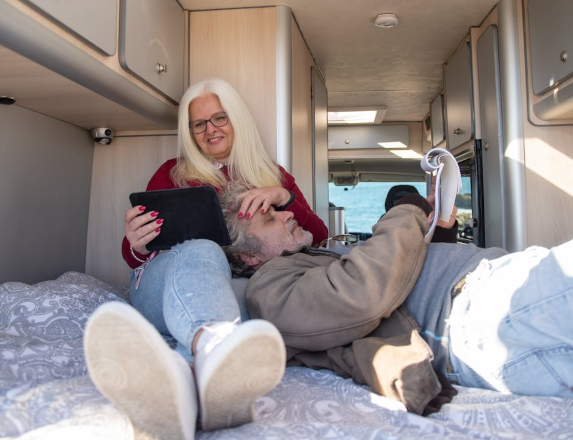
Having a bad day? Is relaxing in the van a Big Lap a ‘downer’? PIC: Kampus Productions / Pexels
Interestingly though, socialising for longer than two hours in a day was not associated with further increases in the probability of reporting a better than typical day.
Time spent on exercise and sports was also positively associated with having a good day … at least up until five hours.
Surprisingly though, spending any amount of time on relaxation and leisure was associated with a lower probability of having a good day. The report’s authors noted though that ‘watching television and movies’ accounted for most of the minutes people spent on relaxation and leisure.
They caution also that bidirectional effects, that is people being more likely to engage in some activities because they were already feeling good or bad, could be a factor.
 “Indeed, bidirectional effects likely help explain the negative association between relaxing and having a good day, because people probably spend more time relaxing when they are feeling down,” the report said. “Still, it is striking that even a little bit of relaxing (e.g. less than an hour) was negatively related to having a good day.”
The other caveat the authors added to their findings was that some activities may be more commonly observed on better days, not because the activities are inherently enjoyable, but because they accompany other positive experiences.
“For example, ‘travel related to eating and drinking’ was positively associated with having a good day, perhaps because a 30-minute drive for food could indicate a meal of perfectly seared scallops at a restaurant rather than freezer-burned fish sticks at home,” the report said.
Grey nomads who excitedly counted down the days until retirement may also be surprised that the report found that working for up to six hours was actually unrelated to whether people rated their day as better than usual.
When individuals worked for more than six hours though, their predicted probability of having a good day rapidly declined.
Veteran traveller Madeleine Claire told the Grey Nomads that even ‘emptying the toilet’ days couldn’t put a dampener on her ‘every day on the road is a good day’ mantra.
“I guess everything is relative and everyone has days that are better than others,” she said. “But grey nomads have such a high baseline that even one of our bad days would probably be a fantastic day for pretty much everybody else.”
Are you a Grey Nomad member yet? Click here to find out about the discounts, competitions and other benefits on offer.








We’ve been travelling for 15 years covering 180,000 kms but have never bothered to do a Big Lap.
We don’t know anyone that has done a Big Lap.