

Sadly, in the past week, a couple of nasty caravan accidents have once again put the spotlight on towing safety … and highlighted once again the inherent element of risk that is associated with any road trip.
Last weekend, a woman in her 50s suffered back and leg injuries after a car towing a caravan rolled on the Bruce Highway at the Sunshine Coast. A second person in the vehicle escaped without injuries. Police are investigating the potential causes.
And just a day earlier, a couple in their 70s were airlifted to hospital after a caravan rollover on the Princes Highway near Batemans Bay in NSW. Two occupants were initially trapped inside the cabin, but the female driver and male passenger were successfully extricated by rescue crews.
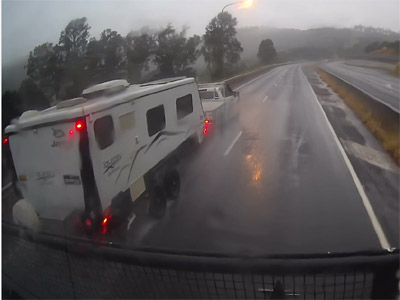
This dashcam footage shows the moments before an accident which took place several years ago on the Bruce Highway. PIC: Maryborough Police
NSW Ambulance service said the woman suffered significant head, chest, and suspected spinal injuries. The man suffered shoulder and abdominal injuries.
While there are similarities between a lot of different caravan accidents, each one has its own set of circumstances.
Some time ago, retired Senior Risk Adviser, Robert Medbury, told the Grey Nomads that it was is best to think of an accident as a ‘process’ that unfolds, not an ‘event’ … and it may unfold over minutes and often over a few seconds.
“The process may have several ‘ingredients’ and the way these ingredients interact (permutations) results in a range of outcomes that spans from a near-miss to death and everything in between,” Mr Medbury said. “Human error certainly contributes to a lot of caravan accidents, but that is only a part of the overall story.”
He said other key elements to consider were:
 Environmental factors: These include, road surface, camber, drainage, horizontal and vertical alignment, sunlight, rain, fog, willy willies, road-side furniture and vegetation, road markings etc to name a few. Some of these matters are critical for determining line of sight or sight distance. If you can’t see very far, then you’re going to have less time to react to problems. For instance, you come around a corner while driving in the country and there is a tree across the road. You will have much less time to react than if the fallen tree was on a straight section of road.
Mechanical (Engineering) issues: Anything that can malfunction is a potential contributing ingredient to an ‘accident’. This includes bearings, brakes, tyre pressures, unsuitable tyres, poor hitch/ coupling selections, unknown ball weights, unknown caravan/trailer weights and steering characteristics that are not fully understood by the driver. Less maintenance on mechanical bits translates into more risk. Well serviced wheel bearings almost never fail. A dirty windscreen and worn windscreen wiper blades would also fall into this category. Other key factors can be blind spots related to wing mirrors and pillars. It is easy to ‘lose a car’ and most certainly a motorbike, behind a pillar. Not being aware of your vehicle’s/rig’s blind spots means more risk.
Procedural issues: How we do things and whether things are done via a fixed set of steps (pre-planning) or whether we play things by ear, all have an impact on risk. As an example, it appears that many drivers drive in thongs. It is unlikely that this practice is risk neutral. How and when we decide to overtake is a major driving decision. Thousands of people have paid the ultimate sacrifice after getting this particular decision wrong. What is the right top cruising speed for your rig? We know we are supposed to match our speed with the driving conditions, though I have seen drivers on the Gibb River Road who have selected an optimistic speed. We know that speed makes us have to make faster decisions and even faster physical reactions. This total time, decision plus reaction, is often longer than the time required to fix the situation. As a result, elevated speed also elevates risk, which can translate into severe outcomes. Anything that you do to reduce risk is a good thing.
Mr Medbury said that there is also a thing called ‘luck’ which can come into play to reduce the severity of an outcome … but said it was sometimes stated that good risk management increases your luck.
“You may think that some matters (risks) are too small for you to bother with such as checking all your tyres and wheel nuts every morning while on the road with the caravan/trailer,” he said. “You may be right … it may be unnecessary … however, how minor individual risks combine to create an ‘accident’ on a particular day, at a particular time and on a particular road defies prediction.”
Mr Medbury said that, in his experience, ignoring small things (sources of risk) that can readily be fixed, is often done so at one’s own peril.
WIN IT-FIT CARAVAN SHEETS
 Grey Nomad members are being given the chance to win some specially made caravan sheets, courtesy of competition sponsor, It-Fits.
It-Fits caravan sheets are made from soft, 100%-Australian, cotton jersey and naturally stretch and flex to adapt to different mattress shapes and sizes without needing custom-made sheets. They fit rounded corners, narrow caravan beds, bunk mattresses, and non-standard sizes while still staying smooth and secure.
Click here to learn more about the competition and how to enter.





A very good article on awareness of all factors that we should take into consideration before and during our travels.
Hi I drive BD trucks and the main thing I see is that a lot of people towing caravans can’t see behind them because they depend on there car mirrors and can’t see anything coming past them then they panic swing hard on the steering wheel over they go . I have seen no less than 10 caravans go over because of improper mirrors . And I tow a caravan to and to see behind you can save your life happy caravanning and be safe
We have moved to WA from Qld, been towing large caravans since 2009, and I see in WA there are a lot of WA towing rigs that do not have towing mirrors fitted. On the east coast it is rare not see anyone without towing mirrors fitted. JAYCO have heaps of different cameras fitted to their Silverline vans but you still require extra fitted towing mirrors legally. A rear camera is not classed as a towing mirror.
As a yearly traveller I’m astounded at the number of caravans being towed by vehicles of a much lower weight than the trailer. This is a recipe for disaster as a small miscalculation or hiccup can cause the heavier section(the trailer) to take over from the lighter section(tow vehicle) and cause a major accident.
Last year on our way home from WA, we were just a block away from home, when we hit the first speed hump, the caravan came off the car. It had a fauty safety lock. We travelled all the way from Esperance to Frankston Vic.