

There is a growing backlash to the seemingly frantic building of giant data centres in Australia, many of which are being planned for pristine regional areas that grey nomads love to visit.
The scale and the speed of the construction projects have caught many by surprise.
The Climate Council says there are 160-odd significant data centres in Australia, with more than 225 in the pipeline … and it says that the growth in data centre proposals has exploded in just a few months.
Many data centres are proposed for regional areas, including an Anthropic data centre in Queensland’s Western Downs that would reportedly be 360 times the size of the MCG.
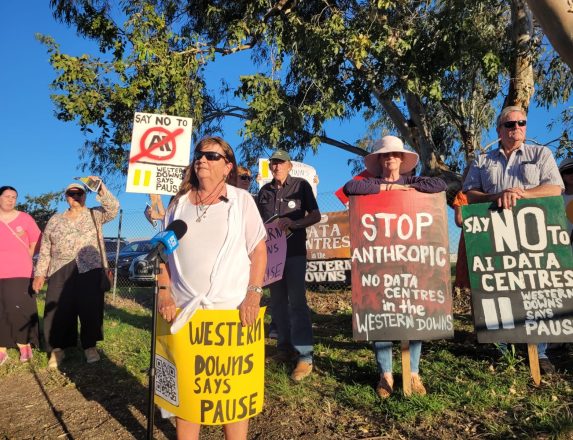
Data centres get the thumbs down from protesters in the Western Downs
Elsewhere, a massive, 2,100-megawatt facility is being proposed for Tungkillo on the edge of the SA River Murray Dark Sky Reserve; a giant data centre complex is being proposed for Moss Vale in the NSW Southern Highlands; a five-storey AI data centre at Maroochydore in the heart of Queensland’s Sunshine Coast; two data centre facilities at Wesley Vale and Bell Bay in northern Tasmania; the giant Project Ares in the Top End; and Project Meridien, and a massive gigawatt-scale data centre proposed for a site about 100 kilometres south of Broome in WA’s Kimberley region.
Anger over the siting of massive data centres in rural America is being cited as one contributory factor to the electoral earthquake which shook the US last week, and it’s fair to assume it’s something political leaders here have taken note of.

Data centres generally need lots of power and water to operate PIC: deeznutz1 /Pixabay
The Federal Government is said to be working on the final details of new data centre rules to be included in draft laws that will be released for public consultation before the end of the year.
Clearly there are massive environmental issues surrounding the centres’ use of power and Data centre anger water, but there are clear potential tourism impacts, too.
Critics says the proposed Tungkillo hyperscale data centre on the edge of the SA River Murray Dark Sky Reserve has the potential to affect the broader Adelaide Hills, Mid Murray and Barossa regions.
Anna Benlow from the ‘Say No to the Tungkillo Hyperscale Data Centre Group’ said this would directly impact the many grey nomads, astro-tourists and other travellers who visit the area.
“People travel specifically to experience dark skies away from urban light pollution and our nearby Dark Sky Reserve is an important environmental and tourism asset,” she said. “A hyperscale Data centres get the thumbs down from protesters in the Western Downs data centre facility of this magnitude, with extensive security lighting, industrial infrastructure and continuous cooling and ventilation systems, raises legitimate concerns about light and noise extending well beyond the boundaries of the development site.”
Dr Andrew Johnson, CEO of Mid Murray Council said it was aware of potential issues with the project which is being proposed by Quantum DC. “Council is seeking information from Quantum DC in relation to these matters as they are yet to be adequately addressed,” he said.
It’s a similar story elsewhere. A $32 billion data centre hub set to be built on Queensland’s Western Downs by Singaporean developer Zerra DC is expected to create thousands of ongoing jobs … but opponents say the negative impacts will far outweigh the benefits.
If it goes ahead, the Western Downs Digital Park near Dalby will be the largest facility of its kind in the country.
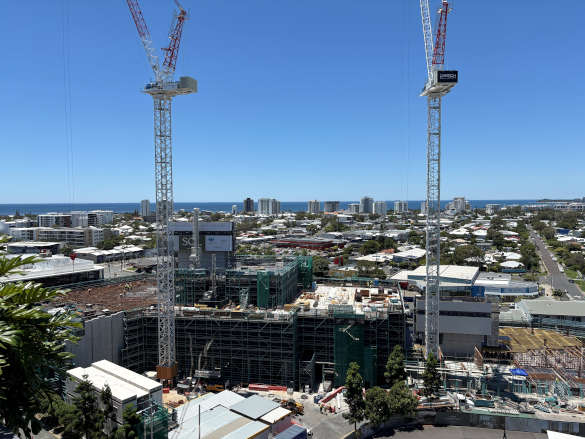
A ‘relatively’ small data centre is under construction in Maroochydore. PIC: Sunshine Coast Council
Angela Prenzler from the ‘Western Downs Says Pause’ is appalled at the prospect, but says it is part of a wider shift which has changed parts of the region over the past 20 years.
“Coal seam gas companies, power companies, solar farms and wind farms now dot a lot of the farmlands surrounding Dalby, Tara and Chinchilla,” she said. “And many farmers have multiple coal seam gas wells on their land … the Western Downs region is being turned into the Energy Capital of Australia.”
‘Western Downs Says Pause’ also has huge concerns about water security in a region often in drought and believes the project will also put a further squeeze on tourist accommodation.
Western Downs Regional Council said the Western Downs Digital Park development application was currently under assessment, and that it must remain impartial throughout the assessment process.
“No steps in the process will be overlooked, particularly when it comes to public notification and opportunities for community input,” said Mayor Andrew Smith.
The explosion of AI data centres across regional Australia has sparked considerable outrage and seen community groups form … and take action.
And it’s an issue that is not going away.
A recent community gathering at Tungkillo Soldiers Memorial Hall opposing the Tungkillo Hyperscale Data Centre, for example, attracted approximately 600 people … an extraordinary turnout for a small SA rural community.
A nearby gathering in Mannum had a similarly strong attendance. Underpinning it is a sense of frustration about not being listened to.
Anna Benlow from the Tungkillo protest group says she wants the authorities to understand that tourism, agriculture and rural living are not obstacles to economic development … they are valuable industries in their own right.
“We have spent generations building regional communities, establishing businesses and creating destinations that people want to visit,” she said.
She says an enormous data centre, accompanied by energy infrastructure, transmission lines, industrial lighting and associated development, will fundamentally change the look and feel of the landscape.
 “People don’t travel to regional South Australia to experience another industrial landscape … they come for the countryside, the peacefulness, the open skies and the connection with nature,” she said. “Once you industrialise a landscape, you cannot simply restore its original character … ancient trees, established wildlife corridors, productive farmland and dark skies cannot be replaced.”
Even if grey nomads did still want to visit the area, Ms Benlow says they might suddenly struggle to find places to stay.
“Places like Mount Pleasant Caravan Park and Cabins provide important stopovers for grey nomads and travellers exploring the region,” she said. “A large construction workforce could put pressure on already limited accommodation, potentially affecting the visitors and tourism operators who support our local businesses.”
But it is clear that Tungkillo is far from alone in facing these sorts of challenges as big tech eyes prime sites for new data centres.
Tasmania is another area famed for its pristine surroundings which is likely to feel the impact … and people are waking up to what it may mean.
New research from Enterprise Marketing and Research Services revealed that more than half of Tasmanians oppose the development of AI data centres in the state.
EMRS Managing Director Brad Stansfield said the results showed the proponents of data centres had a significant job ahead of them to win over the Tasmanian community.
“This is an emphatic result, only one in four Tasmanians support AI data centres, and fewer than one in 10 strongly support them,” he said. “Whatever the economic case for these projects, it has not yet been won with the broader community.”
While the construction of AI data centres in country areas sparks plenty of concern, these complexes are also being built in urban areas … often ones associated with tourism.
In Maroochydore on Queensland’s Sunshine Coast, for example, a five-storey, $200 million NEXTDC AI-ready data centre is already under construction.
 A company spokesperson told the GNT the facility would support the region’s growing digital economy.
“The project is being delivered under an approved development application, with independent noise, vibration and air quality assessments undertaken as part of that process to ensure the facility meets the required standards for surrounding areas,” they said. “NEXTDC also funds its own electricity and water connections and contributes infrastructure charges to Economic Development Queensland.”
A Sunshine Coast Council representative said the NEXTDC SC2 facility would have an approximate capacity of 6MW.
“To provide further context, the approved 6MW Maroochydore facility is significantly smaller than several proposed and existing Queensland data centres,” they said. “For example, the proposed Kogan Western Downs Digital Park has a planned capacity of 2,160MW, while AirTrunk’s proposed Brisbane facility is planned at 300MW.”
The council said these comparisons highlighted the comparatively modest scale of the Maroochydore project within Queensland’s broader data centre landscape.
Are you a Grey Nomad member yet? Click here to find out about the discounts, competitions and other benefits on offer.