

With South Australia’s harmful algal bloom devastating coastal communities, a University of South Australia tourism expert is urging its local communities to show solidarity and find creative ways to support affected regions.
Adjunct Senior Lecturer in Tourism Management Dr Freya Higgins-Desbiolles is asking people to rally behind coastal communities hit hard by the bloom which has killed thousands of marine animals and triggered widespread anxiety and economic pain.
For months, the state’s coastline has been plagued by a large-scale bloom of Karenia mikimotoi, a harmful algae killing marine life and degrading once-thriving underwater ecosystems.
The disaster has also dealt a heavy blow to local tourism and community livelihoods, and has the potential to extend into the peak holiday season.
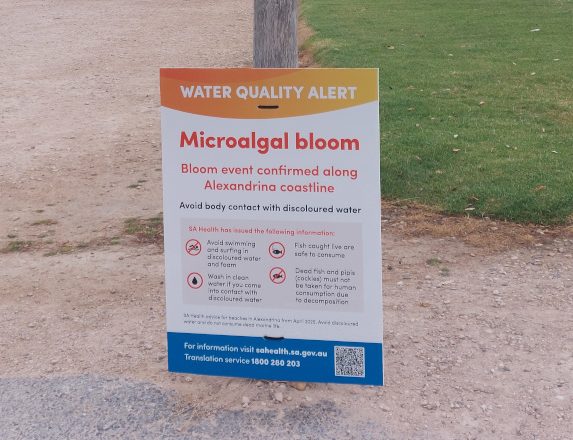
The algal bloom crisis has hit SA tourism hard. PIC: Dr Freya Higgins-Desbiolles
A recent survey by the Tourism Industry Council SA involving restaurants, hotels and marine tourism operators on the Yorke, Eyre and Fleurieu peninsulas, Kangaroo Island and metropolitan Adelaide found that 40% of SA businesses impacted by the algal bloom have experienced a downturn in trade.
The average year on year loss for a business in July 2025 was $52,000, while 14% of respondents reported losses of more than $100,000.
 Dr Higgins-Desbiolles warns that the algal bloom is not going to go away soon, and says travellers should use the crisis as an opportunity to support affected communities and by thinking creatively about how to spend time in coastal hotspots.
“In addition to its economic value, tourism has potential social and ecological value, so we should be focusing on how it can connect our communities and support recovery,” she said. “We might rethink tourism to centre local communities and get their input into recovery policies and planning.”
She said most tourism businesses along the SA coast remain open for business, and although the conditions of the water may differ from time to time, visiting the beach can still be enjoyed, as well as other activities such as taking walks.
“Interstate visitors could also help by staying longer and ensuring their spending goes into local businesses, such as markets, shops, bakeries, pubs and wineries,” she said.
Long term, Dr Higgins-Desbiolles says the biggest threat is to South Australia’s clean and green identity, and its reputation for pristine coastal ecosystems and ecotourism.
“The tourism industry is going to be very hurt by the branding impact, particularly Kangaroo Island which is our key drawcard for tourism,” she said. “The crisis has received attention in international media and so there’s a real concern for the long-term impact to our brand.”
Dr Higgins-Desbiolles says it could also be an ideal time for a niche group of tourists – citizen scientists – to visit affected areas, helping local communities to collect data and boost scientific understanding of the bloom.
“One of the most interesting insights into this crisis has been the number of people who are providing data on the scale of marine deaths,” she said. “Citizen scientists have recoreded 32,000 entries on 480 species of perished marine life, often through the iNaturalist website … these people are helping address the difficulty of the situation by contributing their time and energy.”
* Has the algal bloom affected your plans to travel in South Australia? If you are heading to SA over the coming months, will you be making a bigger effort than normal to support struggling local businesses? Comment below.
Are you a Grey Nomad member yet? Click here to find out about the discounts, competitions and other benefits on offer.






We go to SA to enjoy visiting wineries & many other outdoor activities.
We don’t go swimming or snorkelling in the ocean, therefore the algal bloom doesn’t affect us at all.
We love SA, we think it has some wonderful spots to visit, we’re heading to Port Elliot in the new year and then into the Barossa.
I think it is a shame that South Australia should have this blight on their seascape (and their fishing and tourism industries). After all, SA is doing more in the Renewable Power sphere than any state in Australia, in fact, they could be 100% renewable in a year or so.
We know for a fact that the burning of fossil fuels is the driving factor in Climate Change. and though the algal bloom has many contributing factors the main factor is Climate Change.
Electrical power using fossil fuels contribute about 48% of emission whilst Transport representing 18% of Australia’s annual greenhouse gas pollution.
Last year in October we did a 6000km round trip to Melbourne and back to Yeppoon towing our fully electric caravan with our EV and spent a total of about $450 on fast chargers from renewable energy chargers.
This coming October we are again heading off to Melbourne then onto Kangaroo Island. As a bit of an environmentalist and renewables nerd, I want to see for myself the damage done by the Climate Change induced bush fires and now the algal bloom.
As an aside, our house is totally solar and battery powered our excess power goes back into the grid and pays for our rates.
It can be done folks!
Australia contributes less than 2% of the worlds fossil fuel emissions so by closing our coal fired power stations and increasing our costs of electricity we are not going to save the world while exporting our coal to other countries so they can produce cheap goods and put Australian firms out of business.
If the algal bloom is “Climate Change” created why isn’t there algal blooms elsewhere?
Look for pollution and fertiliser runoff etc.
Don’t go to SA much since it is too hard to find decent camps and the ones we do find are largely (mis)managed by authoritarian entities.