
Western Australia’s spectacular wildflower show is already underway in parts of the state … and grey nomads are already enjoying the annual explosion of colour.
For many travellers, seeing endless fields of everything from pink boronias and red and green kangaroo paw, to magenta paperbark blossom and orange-flowering banksias is one of the highlights of the Big Lap … however long they are on the road.
WA is home to more than 12,000 species of wildflowers, with more than 60% of these found nowhere else. The good news for long-term nomads seeking to maximise their wildflower experience is that it arrives at different times in different regions.
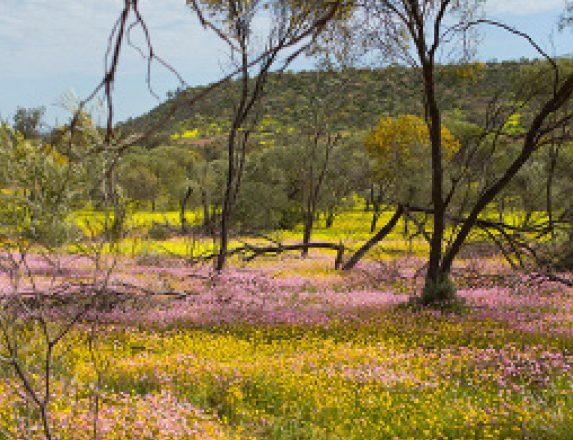
A vibrant wildflower display at Coalseam Conservation Park. PIC: Australia’s Coral Coast
While the weather can change things a little from year to year, tourism authorities say that, starting from this month, the wildflower display slowly makes its way from the red-dirt landscapes of the north to the crashing waves of the Southern Ocean, bringing life to all the fascinating heritage towns, sacred Aboriginal sites, and natural wonders along the way.
In the Coral Coast, unexpected rainfall has meant the season started in good time and species like vibrant mulla mulla and rare native orchids are already in bloom.
In Cape Range National Park, Sturt’s desert pea, Candelabra grevillea, late feather flower, green bird flower, flannel flower, Cape Range grevillea with developing seed pods, and Cape Range poverty bush have made an appearance.
One of the best places to enjoy the show is always Kalbarri National Park where more than 1,000 native plant species will eventually burst into life across the park’s sandstone gorges, coastal cliffs, and sandplains.
Up in the Gascoyne-Murchison, the season is generally at its best from now until the end of August, making it a great time to visit Gascoyne Junction, the Kennedy Range National Park and Mount Augustus. Species to keep an eye out for include mulla mullas, native cornflowers, eremophila, flannel bush, and colourful everlastings.
Peak wildflower viewing time in and around the Wheatbelt and places like Mingenew, Coalseam Conservation Park, and Three Springs is generally August and September when the area comes alive with pink, yellow, and white everlastings. Three Springs is also a great place to see the rare Eucalyptus Rose Mallee, and the Wreath Flower which is unique to small areas of the WA Wheatbelt and Geraldton sandplains. Flowering here from August to October, Wreath Flowers grow to a maximum height of five centimetres, but can be as wide as 50 centimetres.
Around mid September, the wildflower show reaches the Esperance region where the arrival of the likes of kangaroo paw, royal hakea, Beaufortia, claw featherflower, and star flowers bring a new perspective to the epic coastal scenery.
Similarly, the historic attractions and unforgiving landscape of the Goldfields are given a seasonal lift thanks to the bush tomatoes, eremophilas, sundews, everlastings, sturt peas and range of orchids.

WIN DENI UTE MUSTER TICKETS
Grey Nomad members are being given the chance to win one of three admission and camping packages to the iconic Deni Ute Muster event in the NSW town of Deniliquin.
Each package is valued at $800 and includes two General Admission tickets, a reserved campsite, and early entry from Wednesday for the event which this year runs from Friday, October 2, until Saturday, October 3.
Click here to learn more about the competition.
WIN VOLTX LiFePO4 BATTERY SYSTEMS

Grey Nomad members are being given the chance to win one of two fantastic VoltX LiFePO4 Battery systems, with a combined value of nearly $2,500.
With travellers increasingly spending more time off-grid, having a reliable and adequate power source is more important than ever … and these two products will certainly offer adventurers peace of mind on that front.
Click here to learn more about the competition.