

Grey nomad Terry O’Leary and wife Ellie currently travel Australia in a LandCruiser GX 2016 (LC200) towing a 2.6t single axle off-road Kedron … but not for much longer.
In February this year, the electric vehicle (EV) enthusiasts told the Grey Nomads that they planned to swap their ’Cruiser for a Plug In Hybrid (PHEV) or a full Battery EV (BEV) within five years, and then continue their Outback adventures.
Many long-term travellers were quick to express skepticism about the proposed timeframe, and the couple now agree they got it wrong … it’s going to happen much quicker!
“Already Australia has a much better charging EV network with more government support and enterprising businesses and towns seeing opportunities,” said Terry.
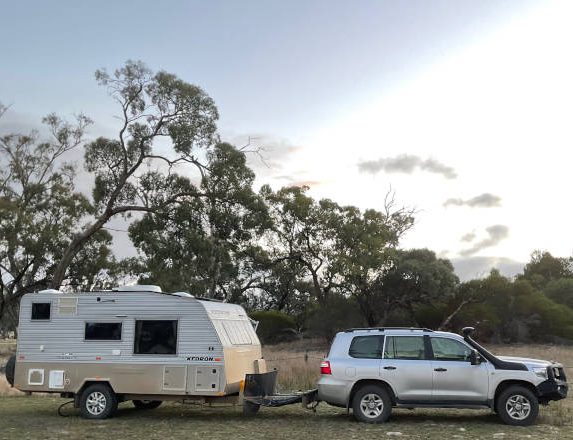
The couple’s rig at Wyperfeld National Park in Victoria … but the ’Cruiser’s days are numbered!
“Many of our smaller towns, hotels, roadhouses, etc are getting chargers to attract travellers and tourists … and even the Nullarbor is just now getting enough DC fast chargers to enable a crossing without using the slower AC chargers.”
But Terry says the most interesting change for grey nomads has been the growing availability of larger EVs, with a wider range of larger Plug In Hybrid EVs (PHEV) arriving in 2024 and 2025 with the capability of towing 3.5t or more.
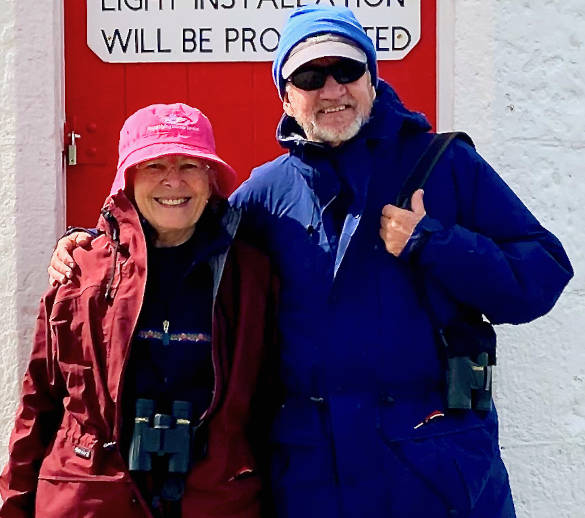
Terry and Ellie at Port Fairy Lighthouse in Victoria.
It all means that, rather than five years, Terry and Ellie think they’ll be replacing their LandCruiser in the next two or three years! Toyota and Nissan will soon release large 4WD Hybrids suitable for towing 3.5t, but Terry says that, unfortunately, they will most likely be non plug-in hybrids, often known as conventional hybrids, with a very small battery (~2kWh).
However, he says many less conservative vehicle manufacturers are stepping up, with some interesting PHEVs recently released overseas likely to come to Australia soon.
“Examples include RAM1500 PHEV 4WD with a 70.8kWh battery and an on-board 3.6l V6 petrol generator,” says Terry. “Its specifications are impressive with 233-kilometre electric range, with a total range 1100km using the onboard generator.”
The vehicle is capable of towing 6.3t as a big American ‘truck’. Ford has also released a PHEV version of its F150.
“KIA has just released its EV9 which is an EV about the size of a Nissan Patrol,” said Terry. “Unfortunately, it appears to be aimed at luxury 4WD market for urban environments … problems like no spare, 19”/21” wheels and 500km of range will limit its acceptance and utility outside of cities.”
However, he says it is a full size 4WD that holds 5-7 passengers and can tow 2.5t.
“Not bad for first attempt by KIA,” said Terry. “We can only hope they will release a version with a spare tyre, 18” wheels, better towing capacity and range, as battery technology improves in next few years.”
He says BYD is also releasing a PHEV ute in Australia next year; and the Tesla Cybertruck is now in pre-release, although it is unlikely to get to Australia for a couple of years.
For those like Terry and Ellie who are dreaming of taking an electric Big Lap, these are exciting times.
“The medium 4WD PHEV and EV market is about to get much more interesting for us grey nomads,” said Terry. “Improving battery technology is inevitable and we are at the slow rising part of very rapid exponential growth in battery and EV adoption … we will all be surprised at how quickly Australian road transport will change by 2030.”
Are you a Grey Nomad member yet? Click here to find out about the discounts, competitions and other benefits on offer.







Whilst EV’s are not my field of expertise, I am certain that an “Electric” Ram 1500 will never legally tow 6.3 tonne in Australia.
The hopes and wishes expressed here are rubbery to say the least, and belong in the science fiction categories.
It is a joke to have electric vehicle with a petrol generator. It is very inefficient to convert petrol to electricity to charge a battery and then drive a motor. Each stage of conversion has losses.
Perhaps you should just pull up at one of the diesel powered charging stations. This whole process is flawed. So don’t run your car off diesel, just use it to charge your battery.
EVs are fine but how many remote roadhouses are powered by diesel generators? The majority of the Nullabor roadhouses are. This means that your EV will still require diesel to run in remote outback areas.
You are right Deborah, and all the roadhouses in WA’s North and most of the towns. I reckon they’re putting the cart before the horse.
By the time EV’s are common tow cars we’ll be to old to travel & staying at home permanently.