

The Middle East may be a long way from Marble Bar and Mataranka, but events in that distant part of the world are continuing to have a huge impact on small rural communities across Australia.
Anecdotal evidence suggests a significant drop in the number of grey nomads and other travellers out on the roads this year and, despite constant talk of imminent peace deals, the uncertainty alone has been enough to give many would-be travellers the jitters.
With President Trump today declaring the war with Iran was all but over, oil prices immediately plunged to a two-month low … but it remains to be seen whether this ‘breakthrough’ will actually translate into a full end to hostilities and, crucially, whether it sees the Strait of Hormuz fully open again.
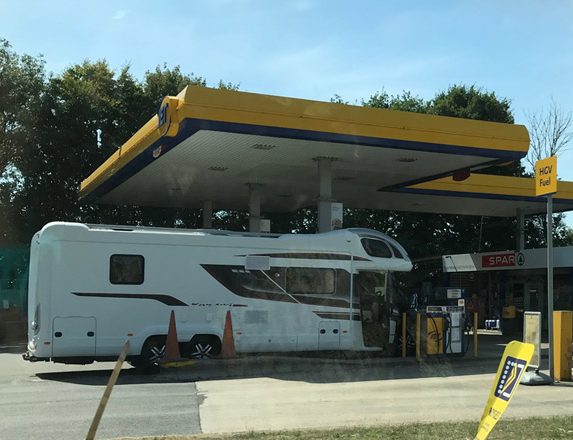
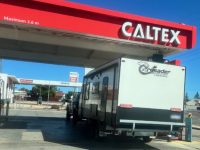
Ouch! Grey nomads in big rigs are really feeling the pain at the bowser. PIC: Cizza
Experts warn that even when the crucial waterway is once more allowing the free movement of vessels, fuel prices will remain elevated for some time.
Another important consideration for grey nomads, of course, is the fact that the fuel excise is due to return to normal levels at the end of this month.
Back at the start of April, after major disruptions to the fuel supply chain and a subsequent shortage, the Federal Government halved its excise on petrol and diesel, which represented a 26.3 cents per litre saving. It said the reduction would last three months.
Combined with the states and territories related decision to forgo increased GST revenue on fuel transactions, the total reduction in excise on petrol and diesel added up to 32 cents per litre.
The Government has consistently maintained that this relief was a temporary measure, and it has asked motorists to operate on the assumption that the excise will return to its full level after June 30.
While all motorists will, of course, be affected by potentially paying an extra 32 cents per litre at the bowser from next month, budget-conscious grey nomads travelling long distances in big rigs will feel the pain more than most.
After the initial concern over fuel security and fuel process when war initially broke out eased, many grey nomads continued to hit the road … but in a modified way.
Veteran traveller Cynthia Kay says she has changed the way she travelled and is taking shorter trips and staying a lot closer to home.
“The whole situation still seems fairly volatile despite the seemingly endless talk of peace being around the corner,” she said. “And if the war does continue and the excise does go back up to its full level in a few weeks, it just takes a big trip up north out of our budget this year.”
* If the fuel excise does go up to its previous level at the end of the month, will it affect your Big Lap plans significantly? Comment below.
WIN IT-FIT CARAVAN SHEETS
 Grey Nomad members are being given the chance to win some specially made caravan sheets, courtesy of competition sponsor, It-Fits.
It-Fits caravan sheets are made from soft, 100%-Australian, cotton jersey and naturally stretch and flex to adapt to different mattress shapes and sizes without needing custom-made sheets. They fit rounded corners, narrow caravan beds, bunk mattresses, and non-standard sizes while still staying smooth and secure.
Click here to learn more about the competition and how to enter.








I live on the Atherton tablelands and was doing a lap in Aug and have cancelled and will be staying in Qld and have 8 weeks off instead of 4 months.
Are you Paul from Possum Vally?
Fuel excise what’s that? Oh, that’s it, a tax on fuel that goes into general revenue and only some of it gets spent on our potholed roads.
We have now sold our little fully electric caravan which we towed with our EV. Our next trip will be from Yeppoon to the Atherton Tablelands a 2200km round trip just using our EV and staying at a private rental “Rainforest Cabin” with a creek, waterfalls in the midst of the rainforest. I know exactly how much I’ll spend at each charging station which varies between 50-65cents/kWh.
We left central Victoria on the 20rh May to head to the gulf. The smaller towns are suffering due to loss of travellers. So far we’ve had no problem getting fuel. Cost has been between $2.14 L to $2.55 per L. We just top up regularly when the price looks OK. Often in the smaller towns rather than cities. These places need their visitors to survive.
We’re glad we took a chance. Things may change and prices will no doubt get dearer, but that’s how it is at the moment.
At the moment, the of $1 per litre variance from one servo to the next, who exactly is ripping what from whom no matter the government tax?
People in big rigs feeling the pinch??
If you can afford a motor home, as shown in the photo, an extra $100 a tank full means bugger all. Feeling the pinch, I think not.
Pensions are feeling the pinch.
My husband and I have postponed out Lap due to fuel price uncertainty. I have cancelled bookings make along the way. It was a long awaited and much anticipated trip..I am pretty devastated at not leaving. I now feel ‘in limbo’ wondering how to fill the rest of the year. We calculated it would cost upwards of $3,000 just to get to Darwin from Perth alone. Its too chilly to head south for short trips and even heading to Kalbarri would be a significant cost. Ridiculous as it may seem, we came across an all inlusive trip to Thailand at a really reasonable price. And here we are.!!….a good place to sit and ponder whether a trip around Australia will ever be affordable. We may have to be creative to finance it , going forward.
I drove from near Perth to Kununurra, leaving on Good Friday & it cost roughly $500 more than usual to drive the 3500km.
Suffering 2 x metastatic cancers in 4 years, I went anyway. Who knows what next year will be offering? Life is very short so please make the most of it if you can.z
Considering that the LNP suggested a 50% reduction in excise on a Friday when this war was in its early stages, our Feral government said it would never happen, only for the Lie-bor party to change their tune on the next WORKING day which was a Monday, I wouldn’t count on them continuing to cut fuel excise but believe they should until life returns to normal. Failing that, at a bare minimum Labor should continue to keep the fuel excise reduction for primary industries AND the transport industry otherwise we’ll see unprecedented rises in grocery prices Australia wide!!
We put our trip off to goldcoast from Tasmania because of fuel crisis,im hoping it will be better next year,also the spirit of tas drops their fuel cost to passengers it cost so much to get to mainland wirh car towing a large caravan,supposed to be our national highway
Adelaide to Darwin fuel price varies $2.25 to Erldunda at $3.15 for diesel. Petrol spy app has been a godsend. Dunmurra roadhouse manager says travellers down by more than half and most caravan parks in Darwin well under capacity. Fuel price in Darwin about $1.90. We all realise outback fuel a bit dearer than capital city but rational thinking and planning minimises being ripped off. Easy to say big rigs can afford it … but some people we have met sold their house to get it. That is their house so the & still has to stretch. The current fuel excise policy will hurt everyone, even people staying home, because everything you eat, drink, or use gets delivered in a non electric truck so it will cost more again. Just like the diesel generators in regional area powering electric rechargers. Have a good day wherever you are.
We went on our planned one month caravan trip despite the high cost of fuel. By staying longer in each stop throughout VIC, NSW and QLD and still spending on groceries, meals and entertainment we are contributing to the rural economies, but using less fuel. That’s a win for the towns we visit and a pleasant trip for us. There were noticeably less vans/RVs on the move during our travels in May and June compared to 2025.