

There have already been a terrifying number of caravan fires this year … and it’s only early April.
Grey nomads and all other RV users are being urged again to do all they can to reduce the risk of fires, and to remain ever vigilant.
Just last week, around 50 firefighters, as well as air support, were called in after a caravan blaze spread to surrounding bushland and – at one point – threatened homes in Perth.
The radio station, 6PR Perth, reports the incident was caused by issues with a lithium-ion battery.
Assistant Commissioner Metropolitan Operations Jon Broomhall told Chrissy Morrissy on 6PR Afternoons that people needed to be aware of the potential dangers.
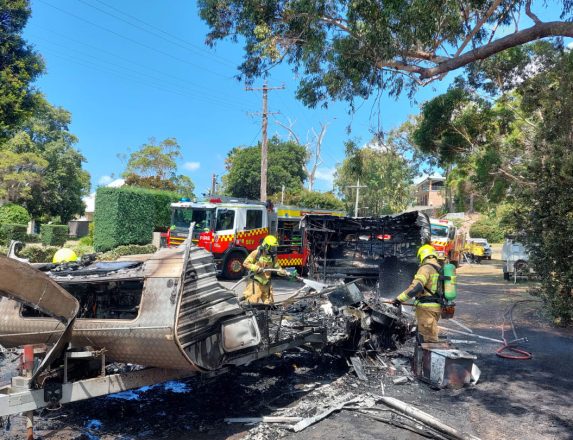
Firefighters extinguishing a caravan blaze in Port Stephens earlier this year. PIC: FRNSW
“It’s really important people change them on a hard surface away from any flammable items … and to have a smoke alarm in and around any property where you’re sleeping, so in your house or in your caravan,” he said. “The best thing to do [if a lithium-ion battery fire erupts] is disconnect it from any power, get it into open air, and douse it with as much water as you possible can.”
Earlier this year, a caravan was completely engulfed by flames in at a property near Mackay in Queensland. And, in a separate incident, a man was airlifted to hospital with non-life threatening injuries after his caravan caught fire in the WA town of Pinjarra.
 Back in late January, a caravan which was initially attached to a car was completely destroyed when it caught fire at Soldiers Point in Port Stephens in New South Wales. Fortunately, no one was inside at the time and no injuries occurred.
Fire experts say that blaze was caused by a faulty gas refrigerator.
“Liquid Petroleum Gas (LPG) is an excellent fuel for heating, cooking and powering camping refrigerators, and is safe if used and maintained correctly,” said FRNSW Superintendent, Adam Dewberry, at the time. “However, if stored or used incorrectly it can become extremely dangerous … firefighters recommend that LPG equipment is inspected regularly, as fires are too often caused by a faulty or loose connection.”
While a working smoke alarm was present in the caravan at the Soldiers Point Fire and alerted the owner, who was nearby, to the drama, that is not always the case.
“Fire crews remind all caravan owners that NSW legislation requires them to have at least one smoke alarm where the bed is inside the van, and one in the annexe if people are sleeping there,” said Superintendent Dewberry.
The Pinjarra caravan fire and Soldiers Point caravan fire came just a week after a family on a long-term trip around Australia lost everything in a blaze which destroyed their caravan and their 4WD tow vehicle.
Nathan and Lauren Goncalves and their children had stopped at a campground at Fitzgerald Bay, about 40 kilometres from the SA town of Whyalla when disaster struck.
Lauren was inside the caravan when she noticed smoke coming from the car, but things escalated quickly despite help from groups of fellow campers.
Nathan, who is an electrician, urged other travellers to regularly check batteries and electrical equipment, and to ensure they always had a fire blanket and extinguisher easily available.

Grey Nomad Members now have the opportunity to win a fantastic Cobb Gas Package, valued at $439. With the base remaining cool-to-touch on the outside, the Cobb allows you to cook on any surface safely with no heat transfer. Ideal for life on the road, camping, boating, beach cook ups, or even just at home. This light (6kg), sturdy, stainless steel cooking system is a dream to travel with.
Click here to find out more about GN membership, the prize, and how to enter.
Members: If you wish to enter, please click here.






If you’re going to write an article about fires in vans and lithium batteries for goodness sake be responsible enough to write in an informative way. This is just going to cause worry and confusion. Which of these fires were actually caused by lithium batteries and why.
I agree that we have to be careful and whilst we need to make people aware we also don’t want to make them afraid. Just venturing out on our roads is a risk in itself but we are never going to stop doing it.
Thank you Rhonda.
Jon Broomhall’s first comment does not appear to make sense to me. “It’s really important people change them on a hard surface away from any flammable items..”. Was it a battery in a hand held device, a scooter, bicycle, car or caravan?
I’ve not heard of this warning before. What does a hard surface have to do with changing a battery.
Apologies if this is a silly question.
Also support Rhonda’s comment.
Looks like a typo. Should be “charge them”. But I agree knowing what the device was would be helpful
Or was it changing gas bottles?
I only got partially into this segment when i read the most stupidest thing ever, “The best thing to do if a Lithium I-on Battery fire erupts is disconnect from any power and get it out in the open “, How crazy is this statement , these batteries may start with a smoulder but then not only catch fire but go off like a afterburner on a jet plane, i Know i wouldnt risk touching one, get ont just let the van burn, dousing them in water does very little due to the intensity , they either burn out or need to be submerged in water.
I agree
Again this subject is reported that is of no use to anyone. What caused the fires? If battery related -clearly define what type of battery, what it was charging and other relevant details.
This type of scare- mongering method of reporting does nothing to help anyone
We have disconnected all gas from our van, it is now fully electrified and yes we have Lithium batteries 5kWhr’s worth with proper installation and a real BMS (Battery management System).
We have one induction hot plate inside and what was the pullout gas stove outside is now a 2 plate induction hotplate. Our inverter is powerful enough to even power our aircon.
Our new car ( which I collect in a few weeks) is an BEV (Battery Electric Vehicle) and will be towing the van all the way Australia.
I’m guessing you have a very light van as I don’t know of any electric car yet available in Australia that can tow much above 1600kg and for short distances.
I’m also guessing you will have to plan your round Australia trip very carefully to find charging stations in remote locations.
Here’s the plan Frank:
I wish you all the luck.
Unfortunately there is a mass of misinformation in relation to lithium ion batteries which is causing unnecessary concern to people.
LiFePO4 batteries which we now install in our vans do not catch fire. They are not the same battery chemistry as you find in electric cars, electric scooters and toys etc which you regularly hear catching fire. In fact they are one of the safest battery chemistries around.
Stop adding to the scaremongering.
Well said Tim
I agree Tim it seems that close enough is good enough when it comes to reporting fires involving batteries. Do some research and investigation before lumping all fires involving caravans together. Show some responsibility and inform people of the facts and make sure your battery fire mitigation strategies are correct before reporting.
Regrettably not all Lithium batteries that people can purchase are the safe construction and safe chemistry. It is buyer beware.
Also, I suggest people familiarise themselves with the risks associated with the emissions produced by Lithium batteries during a thermal runaway. These emissions are extremely toxic to humans and can be incapacitating and in the worst case scenario deadly.
It is not a fire as such, more a self sustaining exothermic reaction, that is capable in some circumstances of producing sufficient oxygen to sustain the reaction. That is why it is difficult to control. Trying to control this with water is often pointless and trying to use a fire blanket on it will not work either.