
Slowly but surely, more and more councils are rolling out ever-stricter rules limiting how long caravans can be left parked on residential streets … and that could be bad news for anyone who hasn’t got a lot of space on their property.
With smaller block sizes and bigger rigs, the issue of vehicle storage for grey nomads and others when not actually on the road is becoming a more pressing one.
Coupled with the strong growth in the caravanning and camping lifestyle, it has all led to what many feel is an explosion on the number of caravans and motorhomes parked in suburbia … and an explosion in the number of complaints about them.
And that’s led to action.

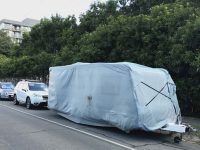
Some caravans are left on the street for extended periods. PIC: Cizza
The Queanbeyan-Palerang Regional Council, in the NSW Southern Tablelands region, is the latest authority to introduce strict residential parking rules aimed at stopping vehicles being left for long periods of time.
It means vehicles longer than 7.5 metres cannot now park in residential streets for more than an hour.
And standard registered vehicle vehicles smaller than 7.5 metres can park in a single untimed street spot for up to 28 days before they must be moved.

Where there’s a will there’s a way! Some owners go the extra mile to make sure they can park their RV in their own property. PIC: Cizza
The council said it evaluates safety, infrastructure damage, environmental harm, and community impact when determining whether certain parking behaviour (especially verge or informal parking) should be restricted or enforced against.
“Council receives a significant number of complaints about parking practices, indicating that the community view this issue as important to them,” it said.
Under its new Priority Parking Enforcement Policy, the council said long and heavy vehicles (either 7.5m in length or greater or with a Gross Vehicle Mass (GVM) over 4.5 tonnes) must not park on the street in a built-up area for more than one hour.
“These vehicles include trucks, trailers, caravans and boats,” it said. “These vehicles must be parked in a manner that does not block traffic flow, obstruct driveways or create dangers for other road users.”
The council said it encouraged people who own non-motorised vehicles such as caravans, trailers and boats to either park them on their own property or seek off-site storage options to ensure these vehicles do not restrict access to parking spaces for others.
“Non-motorised vehicles should not be parked in residential streets, on main roads or in parking areas at parks or community facilities,” it said. “They should not be parked on the verge or tethered to public trees or infrastructure.”
The issue that many ‘paused’ travellers have, of course, is the relatively high cost of many professional storage options and, in some areas, a lack of availability.
Queanbeyan-Palerang Regional Council Mayor, Kenrick Winchester, told the ABC the parking issue was a real problem in the NSW town of Googong, where he said people had ‘bought houses where they can’t fit their boat or their trailer in their own backyards, or sheds, or driveways, and so they’re parking them randomly throughout the suburb’.
 “You bought a house out at Googong and you didn’t plan to fit your big boat or caravan on the property that you bought, then that’s all on you I guess,” he said.
The council said its rangers regularly use cameras to obtain evidence, and that included the use of mobile phone cameras, dash cameras and body worn cameras.
It’s a similar story in Sydney’s Sutherland Shire where ‘following community concerns about the long-term storage of trailers on public roads’, the council is trialling ‘No Parking Motor Vehicles Excepted’ zones at five locations across the local government area (LGA).
A council spokesperson told the Grey Nomads that there would be an initial focus on education and awareness to support compliance with the new restrictions to allow people time to adjust to the changes. A three-week warning period will apply before the trial transitions to enforcement after which trailers parked in the designated areas without a motor vehicle attached may be subject to a $140 penalty.
“In 2025, Council received more than 2,400 reports relating to boat trailer parking and more than 500 reports relating to caravan parking,” the spokesperson said. “Residents raised concerns about visual amenity, reduced sightlines for drivers, safety risks, and the long-term use of public roads for trailer storage.”
Are you a Grey Nomad member yet? Click here to find out about the discounts, competitions and other benefits on offer.