

Parts of the Stuart Highway will reportedly reopen to all traffic by the end of the week after being cut off by flooding.
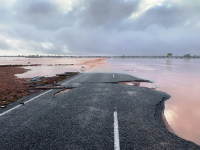
A 250-kilometre stretch of the highway between Glendambo and Coober Pedy has been impassable for more than two weeks due to 400ml deep floodwaters.
However, it re-opened to essential heavy freight and emergency service vehicles yesterday, although in one direction only and at a maximum speed of 20km/h.
The news will come as welcome relief to many communities that have been relying ion airlifts to bring them in the supplies they need to survive.
Authorities plan to allow high clearance 4WD vehicles to cross in one direction at a maximum speed of 20km/h from tomorrow.
A road condition assessment will be conducted mid-week to determine whether blocks of traffic and light vehicles can travel on the road.
The recent heavy rains have left the majority of secondary and remote roads across Central Australia impassable due to flooded creeks and river crossings, and pavement damage.
It’s left place likes Oodnadatta in South Australia totally isolated.
Oodnadatta Pink Roadhouse owner Peter Moore has been flying to Coober Pedy in his light plane to secure supplies for the town … saying the town was ‘an island’ relying on the roadhouse.

The flood-damaged Stuart Highway last week. PIC: Department for Infrastructure and Transport / LinkedIn
“There is no way you can get in or out of Oodnadatta, only by air, because the roads … are totally impassable in north, south, east and west — so we are totally isolated,” he said.
And, even when grey nomads and other tourists are able to move about again, they are likely to find some of the top attractions temporarily ‘out of commission’.
Nova Pomare, the manager of Standley Chasm, in the West MacDonnell Ranges told the ABC that the flooding had washed away sections of the bitumen road and the torn up the walking trail leading to the popular tourist destination.
“I grew up here … and I spoke to a couple of my aunties … never ever has any family member seen it this bad,” she said. “This is probably the 50-year flood that we’ve never seen before.”
Ms Pomare said the flooding had toppled trees and ruined most of the infrastructure around the car park and the seating area at the cafe.
“The bottom half of the car park was like tidal waves … there was water all through our shop and kitchen,” she told the ABC. “We’ve got a really big job ahead of us. It could take a couple of weeks to get us back open again … it’s pretty devastating, but saying that, the creek is beautiful.”

Flooding has left areas like Oodnadatta completely cut off. PIC: Supplied / ABC
Once things settle down, the silver lining for any grey nomads who do head out that way is that all the water could lead to an explosion of flora and fauna.
Director of the centre for ecosystem science at UNSW, Richard Kingsford, said new life emerged immediately after the rain.
“You get this absolute blanket of different-coloured flowers across the desert, which will be particularly spectacular, probably this spring,” he told the ABC. “It attracts this incredible food web of herbivores, invertebrate feeding birds, and you’ve got the predators, the hawks and eagles, and big fish that are eating little fish so it’s an amazing landscape.”









This is just what happens in the outback, when the skies open, there’s water everywhere.
Hence the Golden Rule.. never ever set up camp in Any watercourse.. sadly on utube people show is done a lot.