
For many grey nomads, keeping tabs on trip expenses is about more than adding a bit of interest, it’s vital to ensure that the RV wheels keep turning. So, how much does it really cost to ‘live the dream’? It’s a bit like asking how long is a piece of string as everyone travels differently … but let’s give it a go, anyway.
David and Cathy Miller have a 2013 Mazda BT 50 and tow an Avan Aspire 555, which is strictly a ‘bitumen hauler’. The Sydneysiders avoid takeaways and tend to do a ‘big shop’ every three weeks or so, picking up items like fruit and vegetables in smaller towns as they travel.
The couple has taken three major trips in the last few years and kept meticulous financial records. Below, they explain how they budgeted:

Keeping track of your expenses helps you to stick to a budget. PIC: Pexels
So the decision has been made, ‘we are going on the big, (or small), adventure’.
Depending on how long you are going for there are lots of things that need to be planned for, most of these can be covered elsewhere but one of the big ones is, ‘how much is it realistically going to cost’?
There are a few articles floating about that have headlines like ‘How I travelled for $1 a kilometre’ but, unless you have a good understanding of all the underpinning costs, these can be a bit misleading. The simple ratio between time away and the distance travelled alone will have a big impact on the average daily costs and the total cost per kilometre.
The 5 categories we use for estimating, and keeping track of costs, are:
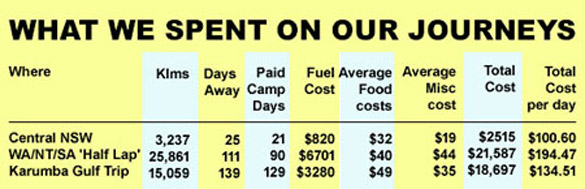
To help provide some idea of cost comparisons we have included a sample of three personal trips:
Rather than trying to be selective and try and discount any particular cost, all the costings quoted include everything spent. It is a ‘warts and all’ comparison and I have just provided some commentary on why some of the costs look so different for each of the trips.
Background:
Our rig is a 2013 Mazda BT 50 with an Avan Aspire 555 – the caravan is strictly a ‘bitumen hauler’ so we always leave it on site somewhere if we want to do some ‘off road’ exploring. The caravan has a reasonably big fridge, and we have a 75lt freezer in the back of the BT 50.
We generally don’t eat takeaway and tend to do a ‘big shop’ around every 3 weeks and pick up consumables, including fruit, bread, vegetables, in the smaller townships as we travel.
We have good coffee makers for the van and always make our morning tea at a rest stop along the way. Lunches are generally leftovers from the previous evening meal or cold meat sandwiches.
Whenever we arrive home from a trip we remove all the food from the van so, just before we leave home for a trip, we restock with consumables, jam, rice pasta, etc, etc. The cost of ‘stocking’ the van is not included in the overall budget, nor is getting the car serviced before we ‘hit the road’.
 Trip One:
This trip was through outback NSW in 2017 where many of the paid campsites were in outback towns where the campsites were not ‘5 star’, but certainly adequate to meet our needs. As an example, the campsite at Pilliga NSW was $5 a night, this provided toilets and showers, and access to the thermal pool, but no power or water.
On this trip we did not do many paid tours preferring to just get the ‘dust between our toes’ and enjoy some of the magnificent countryside on offer.
Also due to the short duration of this trip our average daily food costs were a bit lower than usual as we ran down the stock of food consumables in the van rather than replacing them while we travelled.
Trip Two:
This 2018 trip was across the Nullarbor, down to Albany and then up the West Coast to Darwin, and then down through the centre of NT, SA and NSW. Because we don’t have an off-road caravan we incurred additional expenses in storing our van and hiring an off-road camper in Broome so we could do the Gibb River Rd; and, due to the total distance covered, we also had to get the car serviced twice along the way. The hire of the camper and the car servicing alone added over $2,500 to our costs, this equates to over $22 a day for the entire duration of the trip.
Additionally we did a lot of paid sight-seeing tours on this trip, e.g. the Horizontal Falls out of Broome at a cost of $2,000. This meant that between the camper hire, car servicing and tours there was a big increase in the average daily Miscellaneous Costs for this trip. Absolutely some of the costs could have been avoided, but the Gibb River Rd and the Horizontal Falls were on our ‘bucket list’ and weren’t going to be missed.
Trip Three:
This 2019 trip was to Karumba in the Gulf, and then across to the East Coast of Queensland, and then following the coast back home to Sydney. We incurred about $1,400 in ‘tours’ during this trip, including fossicking for gemstones and a couple of fishing charters. This trip was also a good example of ‘when things go wrong’.
Unfortunately, while we were staying at Ipswich Qld, we received news that a close family friend had passed away, this necessitated a 2,000 k return trip to attend the funeral and provide some support to the family. Fortunately we were staying in a very helpful caravan park who kept an eye on our van whilst we made the return journey, however between fuel, food and accommodation we added around $1,000 to our total trip costs.
Continuing with the ‘when things go wrong’ theme, further down the coast we encountered a sensor issue with our tow vehicle which made further travel, particularly towing a caravan, a somewhat ‘sketchy’ exercise. On the upside, we had the diagnostic tools and expertise to identify the exact problem and was able to get a friend to pick up a part and get it to me, and was able to replace the sensor myself.
This ‘mishap’ cost $300 for the part alone, had it been necessary to tow the vehicle to a dealership, and have them perform the diagnostics and repairs, it would have easily cost upwards of $600.
On this trip we also used took the opportunity to catch up with lots of family and friends that are scattered over central Queensland and the East Coast. Catching up generally meant going out for dinner somewhere, which had a significant uptick impact on our average daily food costs.
Strategies to Contain or Reduce Costs
The first thing to remember is that ‘penny pinching’ and being totally focused on expenses will, no doubt, detract from the overall travelling experience. Before we travel to any destination we do research on the ‘must do/see’ things and budget for them accordingly. We also have an ‘extras’ allowance so we can experience those unexpected things that pop up along the way.
There are quite a few resources you can use to help manage expenses, the three that we use most are:
Others things such as becoming a member of a caravan park group, and not being afraid to flash your ‘Seniors Card’ or Roadside Membership Card will also generate discounts along the way.