

 Grey nomads travelling along South Australia’s remote Oodnadatta Track will soon have access to significantly better medial support, thanks to an innovative initiative from the Royal Flying Doctor Service (RFDS).
The organisation is opening a state-of-the-art health hub in the Outback tourism town of William Creek which will provide 24/7 emergency medical care, although there will be no health professionals physically in the room.
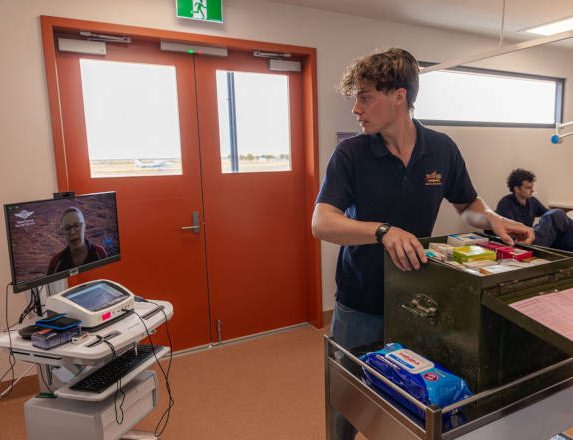
The RFDS's Dr Mardi Steere guides a training scenario at the emergency centre. PIC: RFDS
 In the event of a medical emergency, an intercom on the side of the building enables community members and tourists passing along the Oodnadatta Track to contact the RFDS and access the virtual emergency centre at all times of day and night.
The RFDS virtual emergency centre houses digital health technology, including a telehealth unit with video conferencing and a comprehensive range of interchangeable diagnostic medical devices, connecting patients and their companions with an immediate RFDS Doctor consultation and essential first responder advice.
“Kicking into action after a single emergency telephone call, the virtual emergency centre enables telehealth consultation, diagnosis and treatment with no health professionals physically in the room, 24/7,” said RFDS SA/NT Chair, Peter de Cure. “In the event of an emergency, first responders will be able to use telehealth technology to instantly contact on-call RFDS doctors.:
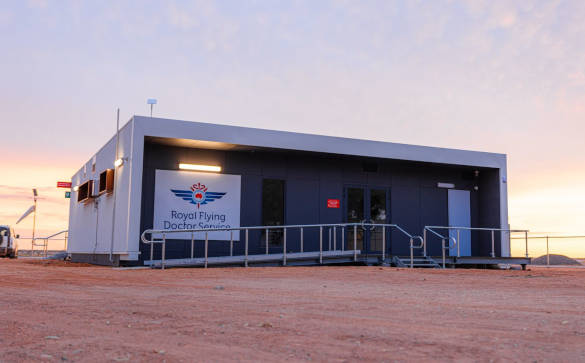
Immediate medical help is now available 24/7 to locals and travellers of the Oodnadatta Track. PIC: RFDS
He said that, with an on-site AED and remote RFDS Medical Chest, the on-call doctor can advise the local medical chest custodian of immediate life-saving medications and care, while patients wait in a safe and secure treatment room for an RFDS aeromedical crew to arrive.
The centre’s portable telehealth unit includes a fingertip oxygen monitor, blood pressure monitor, and electrocardiography leads to help the RFDS with diagnosis.
It also has a comprehensive range of interchangeable medical devices that can transmit high quality images for the on-call RFDS doctor, such as wound assessments, dermatology imaging, and throat and dental examinations – future attachments may also include an ultrasound probe.
“Historically, RFDS teams have consulted with patients at the William Creek Hotel or in the attached tourist accommodation where there are no fixed medical provisions,” Mr de Cure said. “We now have a fit-for-purpose space where our doctors, nurses and even our oral health team, physiotherapist and other allied health clinicians can set up full-scale clinics.”
As the closest town to Lake Eyre North and the gateway to the Simpson Desert, William Creek is a hub for nearby station communities and welcomes more than 26,000 tourists a year travelling the Oodnadatta Track.
“The William Creek Community Health Service will revolutionise health care for residents of William Creek, neighbouring stations and the tens of thousands of tourists who make their way along the remote Oodnadatta Track,” Mr de Cure said.
The RFDS William Creek Community Health Service will be operational from next month.
Are you a Grey Nomad member yet? Click here to find out about the discounts, competitions and other benefits on offer.








ALWAYS give a donation to the RFDS
This could be a game changing idea for rural health.
Could the “Clinic” be fitted within a standard shipping container?
If such first aid Pods be placed in many of the small towns and villages across the Country that currently do not have access to Medical Services it may save lives.