

There is a growing amount of anecdotal evidence to suggest one of the great friendly traditions of the Big Lap is under serious threat … with the country road courtesy wave apparently in terminal decline.
A number of experiments have been carried out by various organisations that indicate the wave return ratio is plummeting with every passing year. Once viewed as an absolute staple of Outback travelling, the full hand wave or even the slightly raised-off-the-steering wheel phatic finger is becoming harder and harder to find.
Some interstate truck drivers say the wave – which to many represents the mateship and camaraderie of the on-the-road culture – has all but died off.
In New South Wales, a campaign called ‘Wave to a Truckie’ has been launched and there is talk of introducing a National Wave Day in the near future.
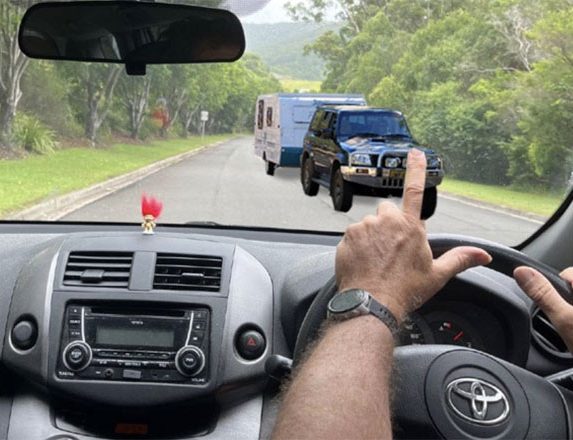
Is the 'wave' to fellow travellers on its way out? PIC: CIzza
In previous years, the WA State Government has tried a similar approach, running a road safety campaign that encouraged drivers to make the friendly gesture a staple of driver etiquette, and bring greater calmness and courtesy to the roads.
But it seems to have largely been to no avail. Several years ago, Charles T, who is a regular driver on the open roads of SA’s Eyre Peninsula, said the wave decline had been disheartening.
 “I’m sorry to say that the grey nomads are the worst at acknowledging other road users,” he said. “There have been times when I would have gone past 30-40 caravanners / motorhomers on a trip and not received one single wave.”
And Terry C says he and his wife make bets with each other about whether they will get a return wave.
“I try to wave to everyone and get surprised when I get truckies wave back these days,” he said. “There are less and less wavers out there and, yes, as you get closer to civilisation, the less wavers.”
A previous study by a leading Australian anthropologist concluded that the waving-on-the-road gesture was an acknowledgement of common humanity which showed our innate desire to interact with those on a similar adventure.
But the ‘phatic finger’, as Dr Adrian Peace from the University of Queensland, labelled the greeting has many subtle nuances.
“Perhaps because of their age, some grey nomads see themselves as informal guardians of morality,” Dr Peace previously told the Grey Nomads. “Australians often bemoan what we consider to be poor manners in public places … but this cordial and Times friendly gesture between strangers proves it is not always like this.”
Dr Peace says travellers may also wave to relieve boredom; because they feel it is the right way to behave; as a way of building a sense of camaraderie; or simply because they feel obligated to reciprocate gestures.
So, does the apparent decline of the ‘wave’ indicate a breakdown in that feeling of connectedness between drivers, or just reflect a wider fall in levels of courtesy … or have reports of the death of the wave been greatly exaggerated?
Are you a Grey Nomad member yet? Click here to find out about the discounts, competitions and other benefits on offer.







Yes the wave is quickly disappearing. We travelled up the Newell a little while back of the 42 caravans and motorhomes we passed, we got 12 waves or finger raised. The outback wave has been disappearing for the last 10yrs. When we first started travelling we would have 70 or 80 percent reply, now its down to 25 percent or less.
I am a slacko……………….sometimes I do, sometimes I dont. I thought about getting one of those headlight washers and putting a hand on it.
We’ve got a 6m motorhome and hardly anyone waves to us but when they do it’s usually caravans, not other motorhomes
No don’t wave. Stupid. Who cares
I remember about 60 years ago when going in the car with my parents and siblings that we were happy to see a car now and then where dad gave a wave. Now-a-days there are a lot more on the roads with caravans where my arm is about to drop off after constantly waving.