

Most of the many grey nomads that travel with a fishing rod in their rig are aware that fish stocks around the world are under pressure.
Of course, there are size limits and bag limits and other regulations in place around the country that are designed to ensure recreational fishers don’t add unduly to the problem.
Now, the Tasmanian Government has gone one step further and is to temporarily close the Sand Flathead recreational fishing zone in South-Eastern waters from March 1.
The latest research from the Institute for Marine and Antarctic Studies (IMAS) shows Sand Flathead stock is depleted below critical levels, particularly in the State’s South East.
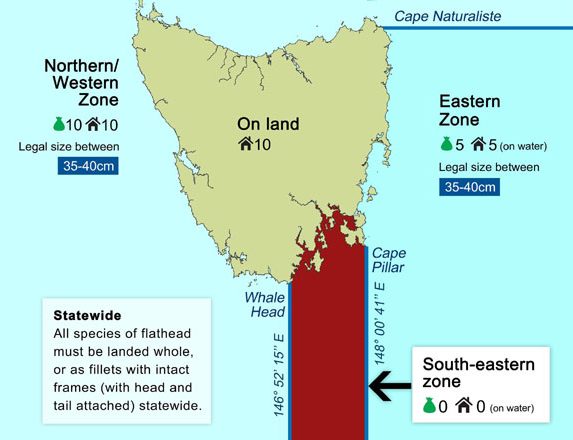
The new flathead rules include a closure in the south-eastern zone and a requirement for all flathead species to be landed whole or as fillets with intact frames. PIC: Fishing Tasmania
The latest research showed fishing for sand flathead was now highly unsustainable in most of Tasmania, with not enough large females, which are critical for egg production. In many areas, 79–100% of fish were below the legal size (35 cm). In the south-east, only 1% were legal-sized.
The State Government says taking strong action now will ensure the Sand Flathead fishery has a future in Tasmania.
 Minister for Primary Industries and Water, Gavin Pearce, said the science was clear, and had to be listened to.
“We want to see our future generations fishing for Sand Flathead, and that’s why we are implementing a temporary closure of the South East Sand Flathead zone,” he said. “While this will be tough for some, I believe our recreational fishers will understand why this decision has been made.”
The Government says that, for all other Tasmanian waters, all species of flathead will be required to be landed whole, or as fillets accompanied by intact frames including a head and tail attached.
The temporary closure of the South East recreational fishing zone will allow for the new IMAS-led stock enhancement program to take effect.
“Our Government has invested $1.2 million for IMAS to conduct a Sand Flathead stock enhancement program in the South East – an essential part of getting Sand Flathead levels back to what they once were,” Minister Pearce said. “This program, paired with the zone closure, will accelerate the rebuilding of the fishery … we want to see our future generations fishing for Sand Flathead, and that’s why we have acted.
The Minister said the speed with which the fish stock recovered would determine when the South East zone reopened.
Further information can be found here.
Are you a Grey Nomad member yet? Click here to find out about the discounts, competitions and other benefits on offer.






Years ago we used to go out into port Phillip Bay & catch 100 Sand Flathead, there was no bag limit.
We live on the bay.
Legal sized Sand Flathead numbers have dropped enormously over the past 20 years obviously because people like us caught too many in the past.
We sold our boat 5 years ago, it wasn’t worth going out in it anymore.
The same thing is happening with Snapper.
WA & SA have closed fishing for them at certain times of the year.
It’ll happen in Victoria as well.
It should happen everywhere that the numbers and size have decreased. Proactive rather than reactive action is always going to cause less long term pain.
Totally supportive. I enjoy my fishing (almost) as much as anybody, but if the breeding stock is not preserved and rebuilt, there will be no decent fish to catch. It doesn’t matter which species or where, preserve them or everybody misses out. One thing I do believe, is that there should be no exemptions for anybody, including First Nation Peoples. The Fish don’t recognise whoever is on the end of the rod or spear, or who is dragging the net: they’re only concerned with survival and breeding, and that is the only thing that we should be concerned about also. Regardless of the specie or historical details.
Agree with you
Yes the breeding stock do need to be preserved.
Beginning in September every year Snapper enter Port Phillip Bay to breed.
At that time every year they are targeted by tens of thousands of anglers.
Most of the fish caught are full of roe (eggs) so what’s going to happen in future years, less fish?
There won’t be a ”Snapper Season”.
Fish farming is a big part of the problem in the SE area, with ever increasing water polution depleting all native fish species.
Totally agree. Came to Tassie in 1998. Was easy to get a feed of nice flathead. More fish farms now and now no flathead. Thousands of tons of fishfood going into the waterways every year and it turns to fish poo which has to go somewhere. This is a major problem being ignored for $ and jobs. Shame on tasmanian governments for allowing this to happen. Im not anti fish farms. Just know it needs to be done on land where the waste can be controlled and monitored so it doesn’t destroy any more of our once beautiful waterways.
How many tons of fish food actually go into our water ways each year?
How many litres of contaminated water from Dover processing factory enter the waterways every day?
If people actually knew the amount they would want action to prevent further destruction.