

For grey nomads who aren’t travelling in large rigs complete with ensuite facilities, it is becoming ever more important to travel with some sort of portable toilet.
While definitions of what actually constitutes a self-contained vehicle may be the subject of some debate, there is no dispute that a growing number of campsites are asking looless travellers to head elsewhere.
And, as the number of campers has increased, so too has the backlash against irresponsible bush toileting … and half-buried human waste and trails of used loo paper.
A long-established option has been the portable chemical toilet but, with dump points not always easy to find, there has been something of a boom in the number of travellers choosing composting toilets.
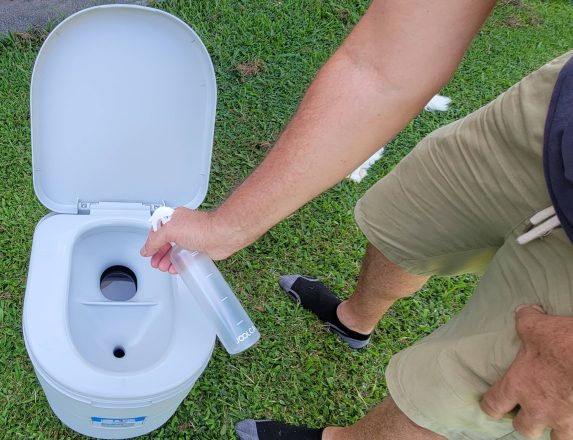
The GottaGo toilet has three disposal options. PIC: Cizza
One of them is Thomas Soltau, who says he and his wife, Di, have enjoyed many, many kilometres of odour-free and environmentally-friendly travel with their composting toilet.
He says that, while there is some maintenance involved with the composting toilet, if you are familiar with composting home food scraps / scrapings from plates and cooking utensils, it does not take much effort and – importantly – it does not involve personal contact with the composting material or cleaning out the body of the composter bin.
“The principle of any composter is to keep oxygen present with the medium being composted,” said Thomas. “This promotes the development and activity of aerobic bacteria that does not produce methane odours.”
 He says that, by contrast, the cassette portable toilet produces anaerobic bacteria which does produce a pungent odour.
“With the compost toilet, the liquid waste and solid waste is kept separate so it involves emptying the liquid waste daily,” said Thomas. “There is no problem emptying this in the bush provided it’s not near ground water, farm crops or near anything growing that humans are likely to consume … the same with the compacted material, as they are completely inert.”
For grey nomads not quite ready to go the ‘full compost’ route, Australian company, Joolca, has come up with a ‘triple-threat toilet’ that allows travellers to either use chemicals, or a bag, or to compost.
The Joolca GottaGo Toilet has two ‘entry points’ which allows it to separate urine and solids, meaning easier and less frequent emptying, and less weight to carry.
The toilet – which weighs 7.7kg when empty and is 43cm high, 38cm wide, and 42cm deep – is airtight and leakproof … and doesn’t smell!
There are actually two solids cassette options … the chemical cassette; or the Eco cassette which can be used for the bagging or composting methods.
Are you a Grey Nomad member yet? Click here to find out about the discounts, competitions and other benefits on offer.





Composting toilets are being banned in some campground especially with dump points
Really? Which ones and for what reason? I’ve heard of one, however without entering your van to have a look how would they know.
There bag and bin toilets, not composting unless you have s compost pile for it to fully become compost with the full breakdown around 3 months
we have a rotating chamber system and only dirt comes out of the chambers after that time
as most council style van park bins are often sorted and nothing worse than putting your hand through the disposed plastic bag into fresh s**t
take it home and dispose of it the way the manufacturer has made the product to make compost or only dispose of it the other way at a local tip
Where do you think soiled nappies go?
And bags of dog poo?
We have a fixed chemical toilet in our van and I was surprised to be asked by the Western Australian Quarantine Officer if we had a composting toilet. I didn’t ask why at the time, but the question indicated that there may be problem with crossing State borders with a composting toilet.
Have emailed WA Quarantine and the coir peat blocks are allowed to be carried as long as they are in unopened, original wrapping.
We have a fully plumbed in system which is painful when it comes to emptying it, To many dump points are only accessible for cassette toilets to be emptied! I’m still in the process of trying to convince the wife into replacing our system with a composting toilet.
For a decade or so our Thetford has been no drama at all, once I worked out a good routine, only use 32% Sodium Percarbonate as the chemical agent, normal paper and just ordinary pine Oclean disenfectant to wipe the bowl and stuff down, no need for overly expensive fancy gear and we don;t suffer from any pong unless the it hasn’t had a daily wipe down, can gets a shake when replaced and when removed……….. 15 years using the same procedure, it works and cost about $9/mth to run, we do long stays off grid and its handy to have 2 tanks for those caught out moments … Replaced a few parts over the years and checked out a compost job at a camp once, followed up with a bit more research but a tad on the expensive side to just replace because its the in thing …. Most of the gear for these RV toilets is all label for the $$ and normal household items are perfectly capable.
We use the same chemical agent and have done so for 18 years. We also use Happy Bowl toilet liners which eliminates any soiling of the bowl. Likewise we use normal toilet paper
Again the advice from the composting toilet brigade is to daily toss the urine “into the bush”. Since humans are basically slack, this means just dumping the urine in a bush nearby the caravan. Soon the whole free camp site starts smelling like a sewer! No wonder some campgrounds are banning composting toilets!
And campgrounds without dump points? The same slack type campers empty their cassettes on the ground.
I am interested in seeing more of the new Cinderella toilets. I think they are from Norway. Solids are incinerated and you just empty a small pan of ash about every 3 weeks. No smell.